
Montreal Summit Tests Clashing Visions for a Post-Trump Global Order
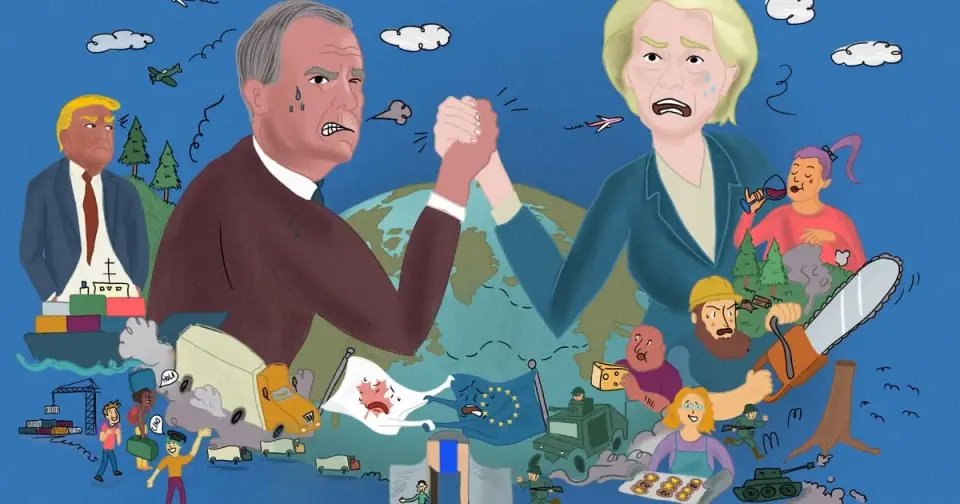
Canada and the EU are set to meet in Montreal to define a new transatlantic alliance, but leaders face a fundamental disagreement over the nature of the partnership. While Prime Minister Mark Carney envisions a broad alliance of 'middle powers' to counterbalance US and Chinese influence, European Commission President Ursula von der Leyen proposes a Brussels-centric model where Canada becomes an 'associate member.' This divergence, combined with unresolved trade disputes and internal EU resistance, threatens to stall the summit's potential for concrete results.
Key points
- Carney and von der Leyen will meet in Montreal to finalize the terms of a new partnership, with a draft joint statement reportedly including Canada's 'associate member' status.
- The 'associate membership' concept lacks a legal definition and has faced pushback from Germany and other EU states, who argue the label was announced before the details were worked out.
- Trade tensions persist, with the EU citing Canadian taxes on cars and wine, while Canada opposes EU deforestation rules and carbon border taxes.
- A new digital trade agreement is being negotiated, but lacks substantive text on artificial intelligence, potentially leading to conflicts with US tech giants.
- Political resistance exists on both sides, including Canadian conservatives fearing EU bureaucracy and EU right-wing parties opposing trade concessions.
Background
This summit follows Carney's September address to the European Parliament and his earlier Davos speech, where he positioned Canada as a key player among 'non-hegemons.' The relationship has been accelerated by US President Donald Trump's tariffs and threats, prompting Canada to diversify trade away from the US. The CETA agreement, signed in 2016, remains only partially implemented, with nine EU member states yet to ratify it fully.
How outlets are covering it
POLITICO highlights the strategic mismatch between Carney's 'middle powers' alliance and von der Leyen's 'associate membership' proposal, noting that four diplomats were not consulted before the latter was floated. CBC emphasizes the need for tangible results, with former envoy Stéphane Dion warning that vague communiqués would be 'depressing' and suggesting 'official observer' status as a more palatable alternative. The Globe and Mail frames the summit as a test of Carney's 'European cousin' narrative, noting that while 79% of Canadians support EU association, the EU's priorities (NATO, Ukraine) differ from Canada's. Yahoo focuses on the geopolitical shift, quoting experts who view the alliance as a necessary hedge against US unpredictability, while noting resistance from French farmers and Canadian conservatives.
Why it matters
The outcome of this summit will determine whether Canada and the EU can create a viable alternative to US dominance or if internal divisions and trade disputes will render the partnership symbolic. Success could reshape global trade and security architectures, while failure may leave both sides vulnerable to US pressure and Chinese influence.
What to watch
Leaders are expected to sign a joint statement outlining steps for digital security, defense, and resource cooperation. They must resolve the definition of 'associate membership' and address trade irritants to prevent the partnership from stalling. Future talks will likely focus on AI regulations and Ukraine funding commitments.
- Canada and Europe want to reshape the global order. But whose vision will prevail? POLITICO.eu
- Canada needs concrete results from EU summit this week, former envoy says CBC
- Opinion: Carney’s drive to make Canada a European cousin encounters a messy reality The Globe and Mail
- Canada-EU summit seeks deepened alliance as US ties fray Yahoo
- THIS WEEK: the EU’s new Canada offer, cash for farmers and Russia’s Lavrov returns to G20? EUobserver
Want the full story? Read the original reporting
Read on POLITICO.eu