
Philippine Defense Secretary Confronts China's Diplomatic Note at Seoul Defense Dialogue
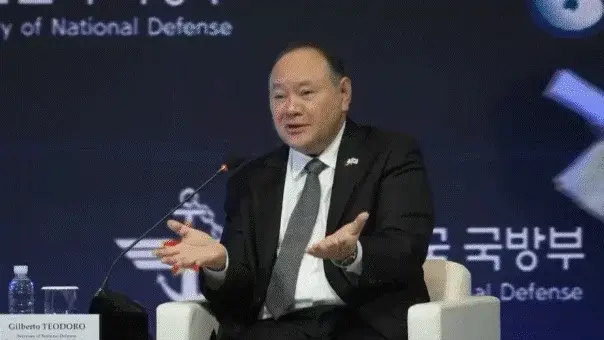
During the Seoul Defense Dialogue, Philippine Defense Secretary Gilberto Teodoro publicly read and rejected a note from China regarding the South China Sea arbitration, labeling the act as coercive and a violation of international norms. The incident drew strong support from U.S. experts and highlighted ongoing tensions between Manila and Beijing over maritime sovereignty.
Key points
- Teodoro interrupted his speech to read a note delivered by a man in a white coat, which stated China's position that the 2016 South China Sea arbitration violates international law.
- The note referred to the 2016 Permanent Court of Arbitration ruling, which found China’s land reclamation in the Philippines' territorial waters unlawful.
- Teodoro criticized the delivery of the note as 'coercion, bullying, and aggression,' arguing it disrespected both international law and the host nation, South Korea.
- U.S. experts, including figures from the Hudson Institute and Heritage Foundation, praised Teodoro’s response as a model for confronting Beijing and stabilizing regional politics.
- China’s Foreign Ministry reiterated its commitment to regional peace and stability, rejecting accusations of major-power confrontation.
Background
This incident follows a series of diplomatic tensions involving China and other Asian nations at international forums. In early September 2026, China warned of consequences after Taiwan attended the Pacific Islands Forum in Palau, leading to accusations of 'wolf warrior' diplomacy. The current dispute in the South China Sea has been a long-standing issue, with the 2016 arbitration ruling favoring the Philippines but not being complied with by China. Recent naval standoffs, including one in March 2025, have further escalated tensions between the two countries.
How outlets are covering it
Fox News emphasized the dramatic nature of Teodoro's response, highlighting his characterization of China's actions as 'coercion, bullying, and aggression.' In contrast, China Daily reported that China remains committed to peace and stability in the Asia-Pacific, rejecting the notion of major-power confrontation. Chosunilbo focused on the positive reception from U.S. experts, who viewed Teodoro's stance as a stabilizing force in international politics. The outlets differ in their framing: Fox News and Chosunilbo highlight the confrontational aspect and U.S. support, while China Daily presents a more diplomatic and measured response from Beijing.
Why it matters
The incident underscores the growing assertiveness of the Philippines in challenging China's maritime claims and the increasing support from U.S. allies. It also highlights the broader geopolitical tensions in the Asia-Pacific region, where China's actions are increasingly viewed as destabilizing by some nations. The response from U.S. experts suggests a shift in how Southeast Asian nations are engaging with China, potentially influencing future diplomatic and military cooperation in the region.
What to watch
The incident may lead to further diplomatic exchanges between the Philippines and China, as well as increased support from U.S. allies. It could also prompt other Southeast Asian nations to adopt a more assertive stance in international forums. China may respond with further diplomatic or military measures to assert its claims, while the U.S. and its allies may deepen their cooperation with the Philippines to counter Beijing's influence.
- Philippines defense chief calls out China after note interrupts remarks at Seoul forum: 'Coercion, bullying' Fox News
- Philippines' Teodoro says China could exploit cuts in US-South Korean exercises Reuters
- ‘Have Some Shame’: Philippine Defense Chief Slams China on Stage bloomberg.com
- China committed to Asia-Pacific peace, rejects major-power confrontation chinadailyasia.com
- Philippine Defense Secretary Condemns China's South China Sea Actions, Wins U.S. Praise 조선일보
Want the full story? Read the original reporting
Read on Fox News