
Senegal rights group demands inquiry after 39 die in Atlantic boat sinking
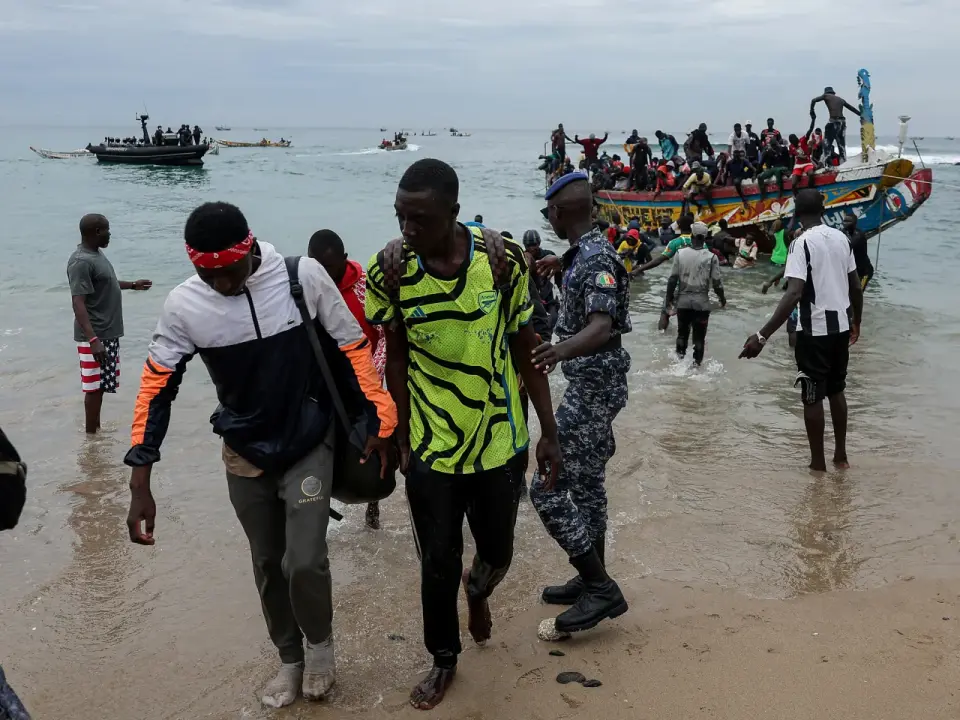
At least 39 people died after a migrant boat capsized off Senegal’s coast on Sunday, with only one survivor rescued. The Senegalese human rights group ADHA is demanding a parliamentary inquiry, citing a lack of progress in reducing deaths despite government spending on naval operations. Meanwhile, Spain’s Canary Islands declared an emergency as arrivals surged, with over 3,300 migrants reaching El Hierro in November alone.
Key points
- A flat-bottomed boat departed Saint-Louis, Senegal, heading to Spain’s Canary Islands but capsized off the Kebemer department, 180km north of Dakar, on Sunday.
- The death toll rose from an initial 21 to 39 as search and rescue operations continued; only one passenger was rescued alive, and several others remain missing.
- Senegal’s human rights group ADHA called for a parliamentary investigation, criticizing the government for failing to achieve lasting results despite allocating 300,000 euros to the Navy and training over 300 agents.
- President Bassirou Diomaye Faye offered condolences and pledged to dismantle trafficking networks, while the Interior Ministry stated it would strengthen cooperation with neighboring countries to combat people-smuggling.
- Spanish authorities declared a state of emergency on the island of El Hierro after more than 3,300 people arrived via approximately 30 boats since the start of November, a number nearly equal to the island’s population.
Background
This incident occurs against a backdrop of rising fatalities on the Atlantic migration route. In the first five months of 2026, 635 people died attempting to reach the Canary Islands, the highest toll among routes monitored by the group Walking Borders. The route has gained prominence as tighter controls and cooperation between European and North African states have diverted some journeys away from the central Mediterranean. Additionally, high unemployment in Senegal, with nearly one in four young people jobless in the second quarter of 2026, continues to drive migration despite the significant risks involved.
How outlets are covering it
Al Jazeera emphasizes the political response, highlighting ADHA’s demand for a parliamentary inquiry and the government’s previous financial commitments to naval security. BBC Africa provides detailed demographic and statistical context, noting that all recovered bodies were Senegalese and citing Walking Borders’ estimate that 21 people die for every 100 who reach the Canary Islands. ABC News focuses on the immediate humanitarian crisis, detailing the rescue efforts and the broader economic drivers, such as poverty and high unemployment, that push young Senegalese toward dangerous Atlantic crossings. All sources agree on the rising death toll and the government’s pledge to combat trafficking networks, but they differ in emphasis: Al Jazeera focuses on accountability, BBC on the scale of the crisis, and ABC on the socio-economic root causes.
Why it matters
The sinking underscores the lethal risks of the Atlantic migration route and the growing pressure on both Senegalese and Spanish authorities to manage the crisis. The demand for a parliamentary inquiry signals potential domestic political friction over migration policy, while the emergency declaration in the Canary Islands highlights the strain on European border management. The high unemployment rate in Senegal suggests that without significant economic improvements, the pressure to migrate will persist, potentially leading to further tragedies.
What to watch
Search and rescue operations will continue along a 25km stretch of coastline, though strong ocean currents are complicating efforts. The Senegalese government is expected to intensify its crackdown on people-smuggling networks, potentially involving greater cooperation with neighboring countries. In Spain, authorities will likely maintain the state of emergency on El Hierro as they manage the surge in arrivals. The outcome of the parliamentary inquiry demanded by ADHA will determine whether there are significant changes in Senegal’s approach to migration and maritime security.
- Senegal human rights group demands government action after deadly sinking Al Jazeera
- Shipwreck Off Senegal Kills Dozens as Canary Islands Declare Migrant Emergency The New York Times
- Canary Islands: 39 dead after migrant boat sinks off Senegal en route to Europe BBC
- Death toll rises to 39 after migrant boat capsizes off Senegal ABC News - Breaking News, Latest News and Videos
- 21 dead after boat carrying migrants sinks off Senegal coast AL.com
Want the full story? Read the original reporting
Read on Al Jazeera