
Tsentr-2026 Drills Rehearse Cross-Border Offensive in Central Asia
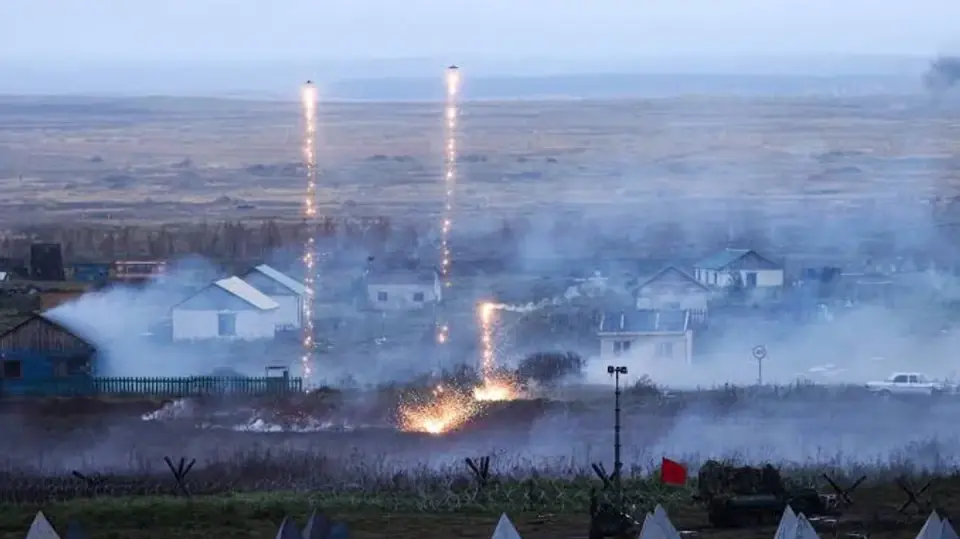
Russian forces conducted the Tsentr-2026 strategic military exercises from September 28 to October 3, involving 47,000 personnel and 2,000 pieces of equipment. While officially framed as defensive drills against aggression in the Caspian region, Deputy Defense Minister Yunus-bek Yevkurov confirmed that troops practiced offensive operations to 'liberate captured territory' and establish a 'security zone' in adjacent lands. President Vladimir Putin visited the Chebarkul training ground in Chelyabinsk Oblast on October 2 to oversee the maneuvers, which included strikes by four long-range bombers and participation from six foreign nations. Analysts suggest Kazakhstan is the likely simulated adversary due to its geographic proximity and Caspian coastline, though Moscow has not officially named the target. The exercises explicitly integrated tactical lessons from the war in Ukraine, despite claims that units involved are not currently deployed there.
Key points
- Tsentr-2026 involved 47,000 troops, 2,000 equipment units, 90 aircraft, and 77 naval vessels across 11 military ranges and the Caspian Sea.
- Deputy Defense Minister Yunus-bek Yevkurov stated that coalition forces transitioned from defense to offense on October 2, practicing the creation of a 'security zone' in neighboring territory.
- Vladimir Putin visited the Chebarkul training ground on October 2, isolating the city for three days, and emphasized that the drills incorporated combat experience from the war in Ukraine.
- Foreign contingents from Belarus, China, Kyrgyzstan, Mongolia, Pakistan, and Tajikistan participated in the multinational exercises.
- Four long-range strategic bombers conducted simulated strikes on critical infrastructure of the hypothetical adversary.
Background
These large-scale drills follow a pattern of previous Russian strategic exercises, such as Centre-2019 and Centre-2015, which involved even larger troop numbers and simulated neutralizing hostile states. The current maneuvers occur amid a broader expansion of the Russian military, with Putin signing a decree in September 2026 to increase the armed forces to over 2.4 million personnel. Additionally, the drills coincide with heightened tensions on NATO’s eastern flank, where Poland is drafting 'pre-war' defense legislation in response to Russian threats.
How outlets are covering it
Ukrainska Pravda and Kyiv Post both report that the exercises included offensive operations to create a 'security zone' in adjacent territory, contradicting the official Russian narrative of purely defensive repelling of aggression. Both outlets note that Kazakhstan is the most plausible simulated adversary due to its border with Chelyabinsk Oblast and access to the Caspian Sea, though Kyiv Post emphasizes that this identification remains an analytical assessment rather than an official confirmation. AP News provides a more neutral overview, focusing on Putin’s presence and the scale of the mobilization without explicitly detailing the offensive 'security zone' aspect as prominently as the other two sources. All sources agree that the drills integrated lessons from the war in Ukraine, despite Kremlin claims that the units involved are not currently deployed in that conflict.
Why it matters
The explicit rehearsal of cross-border offensive operations and the establishment of 'security zones' in neighboring territory signals a potential shift in Russian military doctrine, moving beyond defensive posturing to proactive expansion. The integration of lessons from the war in Ukraine into these drills suggests that Moscow is preparing to apply its current combat experience to new theaters, potentially in Central Asia. The involvement of multiple foreign nations, including China and Pakistan, indicates a broadening of military alliances and cooperation, which could have significant geopolitical implications for regional stability and NATO’s eastern flank.
What to watch
Observers will monitor whether Russia conducts further large-scale exercises that include offensive components or if there are any diplomatic repercussions from the simulated 'security zone' operations. The integration of lessons from the war in Ukraine may lead to changes in Russian military doctrine and tactics, which could affect future conflicts. Additionally, the participation of foreign nations in these drills may lead to increased military cooperation and alliances, potentially altering the balance of power in the region.
- Russia rehearses invasion and occupation of Central Asian country during military exercises Українська правда
- Putin observes military drills in the Urals involving troops from China and other nations AP News
- Moscow Simulates Offensive, ‘Security Zone’ in Central Asia Drills Kyiv Post
- Putin Views Military Drills Against Aggression on Land, Caspian Bloomberg.com
- Chinese troops line up for Russia’s Tsentr-2026 exercise as military ties tighten South China Morning Post
Want the full story? Read the original reporting
Read on Українська правда