
Merz links EU budget approval to mandatory Ukraine funding, defying four member states
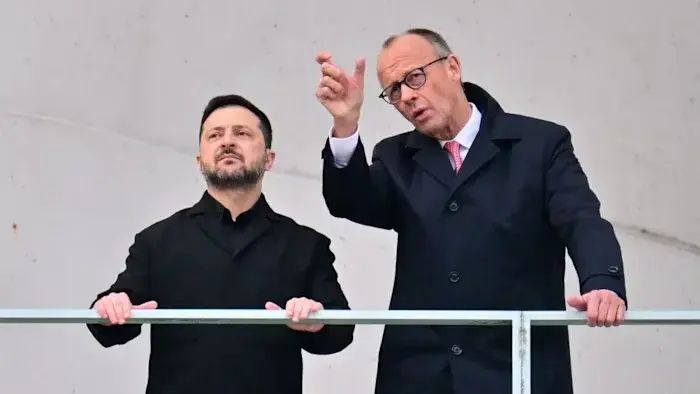
German Chancellor Friedrich Merz has issued an ultimatum, threatening to block the EU’s 2028-2034 budget unless all member states commit to funding Ukraine’s €70bn financing gap. This move aims to prevent future vetoes from Hungary, Slovakia, Bulgaria, and the Czech Republic, while Kyiv seeks to embed aid in long-term budgets to survive political shifts. The European Policy Centre argues that a differentiated accession deal is necessary to balance reconstruction needs with EU budget pressures.
Key points
- Merz wrote to European Council President António Costa, making his support for the next EU budget conditional on all member states contributing to Ukraine’s 2027 funding needs.
- Ukraine faces a €70bn financing gap for 2027; the EU has pledged to cover approximately €45bn, but four countries have signaled they will not contribute.
- Berlin is pushing to change voting rules from consensus to qualified majority for future Ukraine funding to avoid vetoes from net beneficiary states.
- Ukraine is working to include its financial needs in the three-year budgets of European states to prevent aid cancellation following future elections or government changes.
- The European Policy Centre suggests a differentiated accession settlement, including a €100bn reconstruction vehicle and phased cohesion funding, to manage budgetary impacts.
Background
This standoff follows a stalemate at the October 2026 EU summit, where leaders deferred decisions on Ukraine’s 2027 funding and the long-term budget. In late October, Merz visited Kyiv amid Russian strikes, pledging €1.3bn in aid, while earlier in the month, he faced domestic political crises involving the AfD party. The current dispute occurs against a backdrop of upcoming elections in Italy, Poland, and France, which could further complicate consensus-based funding decisions.
How outlets are covering it
The Financial Times highlights Merz’s leverage as the largest net contributor to the EU budget, using the 2028-2034 budget negotiations to force compliance from four countries that previously opted out of interest payments on a €90bn loan. The European Policy Centre offers a structural perspective, arguing that simply extending current budget rules to Ukraine would strain agricultural and cohesion funds, and instead proposes a differentiated accession model that harnesses Ukraine’s economic strengths. Ukrainian sources, cited by Antikor, emphasize the strategic need to lock in funding through multi-year budgets to insulate aid from political volatility, noting that European partners view the requested €70bn as excessive but are willing to partially cover the shortfall.
Why it matters
The outcome determines whether Ukraine receives sustained, multi-year financial support or faces a funding vacuum in 2027. It also tests the EU’s ability to manage enlargement and reconstruction costs without triggering a broader budget crisis, potentially reshaping the bloc’s fiscal architecture and voting mechanisms for future aid packages.
What to watch
EU leaders will meet in Dublin on Thursday and Friday to address the funding shortfall. The European Commission is expected to present options for fulfilling the €45bn pledge, including joint debt issuance, with a target agreement by year-end. Meanwhile, negotiations on the 2028-2034 budget will continue, with Berlin pressing for qualified majority voting rules to bypass future vetoes.
- Germany issues ultimatum to secure Ukraine funding Financial Times
- Ireland Calls for Ukraine Funding to Be Central to EU's Seven-Year Budget - Oj Odessa Journal
- Ukraine’s accession needs a different EU budget deal EPC, European Policy Centre
- Ukraine wants to secure financial assistance in the EU budgets so that it is not canceled after changes of governments, — UP АНТИКОР
Want the full story? Read the original reporting
Read on Financial Times