
Poland's Constitutional Crisis: Tusk's Rule of Law Push vs. Nawrocki's Veto
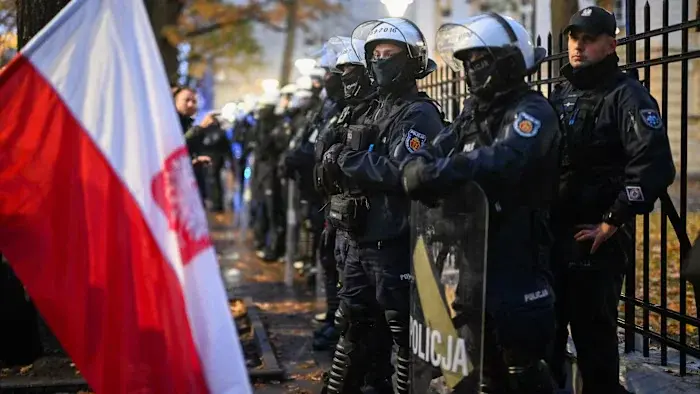
Poland faces a severe constitutional standoff as Prime Minister Donald Tusk’s government suspended the leadership of the Constitutional Tribunal to install new judges, defying President Karol Nawrocki’s vetoes. This crisis stems from an 11-year struggle over judicial independence following the Law and Justice party’s capture of the judiciary. While the European Commission and Council of Europe support the parliamentary appointments, the confrontation risks setting dangerous precedents for bypassing constitutional procedures and has emboldened far-right figures across Europe.
Key points
- President Karol Nawrocki abandoned a trip to Senegal to physically enter the Constitutional Tribunal building, challenging the suspension of its president and deputy, whom he labeled a threat to national security.
- The dispute centers on six new judges elected by parliament in 2026; Nawrocki swore in only two, refusing the other four as political appointees, leading to their oaths being taken inside parliament.
- The Council of Europe’s Venice Commission ruled that the president has no discretion to reject judges duly elected by the lower house, a position reaffirmed by the European Commission.
- The standoff is the culmination of an 11-year conflict where the Law and Justice party stacked the judiciary with loyalists, leading Brussels to freeze billions in EU funds over rule-of-law concerns.
- The crisis has emboldened far-right figures, including France’s Marine Le Pen, who framed the events as an EU double standard and a forced takeover of a constitutional body.
Background
This crisis follows years of tension between the pro-democratic government of Donald Tusk and the PiS-backed presidency. Tusk’s coalition, elected in 2023, pledged to depoliticize the judiciary and unblock frozen EU funds. However, its reform efforts have been blocked by Nawrocki’s vetoes, leading to a deadlock that has intensified ahead of next year’s parliamentary elections.
How outlets are covering it
The Financial Times frames the crisis as a dilemma for Tusk’s government: how to restore the rule of law without resorting to extralegal methods that could set dangerous precedents. It notes that while Tusk’s actions are necessary to unravel PiS’s legacy, bypassing constitutional procedures risks empowering future illiberal leaders. The Guardian emphasizes the legal and moral support for Tusk’s actions, citing the Venice Commission and European Commission, but warns that the confrontation has handed a political opportunity to PiS leader Jarosław Kaczyński and emboldened far-right figures like Marine Le Pen, who are using the crisis to challenge EU authority. Both outlets agree that the standoff has wider implications for the EU and Poland’s political stability.
Why it matters
The crisis threatens Poland’s status as a stable EU member and could set precedents for bypassing constitutional procedures. It has emboldened far-right figures across Europe, potentially leading to open confrontations with Brussels. The resolution of this crisis will determine whether Poland can restore its rule of law and unblock EU funds, or if it will face further political instability and international isolation.
What to watch
A potential path to resolution lies in Nawrocki accepting the Venice Commission’s ruling and swearing in the remaining judges. In return, Tusk’s government must commit to a transparent and legally defensible process for resolving disputed appointments. The key test for Tusk’s coalition is whether it can leave Poland with checks and institutions that no future leader can manipulate, ensuring a stable and democratic future.
- Poland’s struggle to restore the rule of law Financial Times
- The Guardian view on Poland’s political turmoil: an ominous portent of bigger battles to come | Editorial The Guardian
- Explainer: What's behind Poland's constitutional crisis? Reuters
- Russia Senses Opportunity in Polish Political Turmoil The New York Times
- Poland’s fight over its constitutional court gets physical The Economist
Want the full story? Read the original reporting
Read on Financial Times