
Ancient DNA Traces Celtic Language Spread to Eastern European Migration
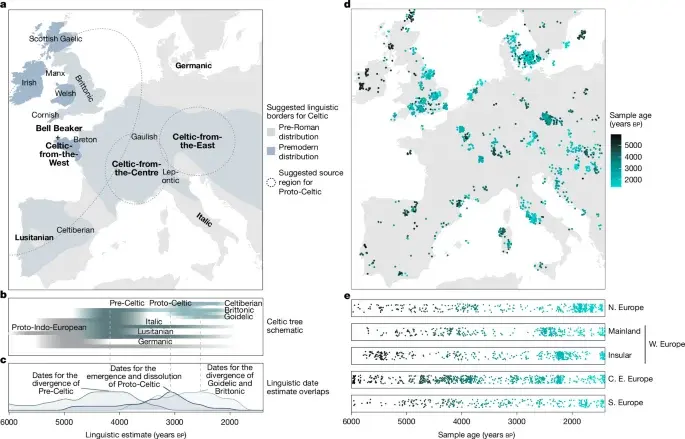
A new study in Nature analyzes 4,587 ancient genomes to trace the spread of Celtic languages, finding that a westward migration from eastern central Europe around 3,200 years ago best explains the language's historical distribution across Europe. While earlier movements from the Atlantic and Steppe regions occurred, the genetic signature of the Urnfield culture aligns most closely with the emergence of Proto-Celtic. This research, part of a broader effort to map Indo-European language dispersals, challenges previous theories that placed Celtic origins solely on the Atlantic coast or in inland France, suggesting instead a complex demographic history driven by population movements from the east.
Key points
- Researchers analyzed genome-wide data from 4,587 ancient individuals to test four competing models for the origin and spread of Celtic languages.
- The study identifies three main demographic processes: Steppe-related ancestry arrival via Bell Beaker groups, a Bronze Age movement from southwestern Europe to Britain, and a westward expansion from eastern central Europe.
- The westward expansion of ancestry related to the Late Bronze Age Knovíz-Urnfield culture (3,200–2,800 bp) is identified as the most parsimonious explanation for the spread of Celtic languages.
- This migration affected France, the British Isles, northeastern Iberia, and Italy, aligning with later Iron Age Hallstatt and La Tène cultural contexts.
- The findings suggest that while Celtic languages may have roots in earlier Atlantic and Steppe movements, their widespread distribution across Europe is primarily linked to a demographic shift from eastern central Europe.
Background
Previous debates on Celtic origins have centered on four models: the Bell Beaker model, the Celtic-from-the-West model, the Celtic-from-the-Centre model, and the Celtic-from-the-East model. While Indo-European languages are widely accepted to have spread from the Pontic Steppe around 5,000 years ago, the specific routes and homelands for Celtic remained contested. Recent genomic studies have begun to resolve similar questions for Germanic languages, revealing unexpected migration patterns that challenge traditional timelines. This new research builds on those methods, applying them to the Celtic context to provide a clearer demographic picture of prehistoric Europe.
How outlets are covering it
The primary source, Nature, emphasizes the 'Celtic-from-the-East' model, arguing that the westward spread of Knovíz-related ancestry is the most parsimonious explanation for the distribution of Celtic languages. Secondary sources, including Yahoo and The Conversation, highlight the broader implications of the study, noting that it challenges long-held beliefs about Celtic origins on the Atlantic coast. The Conversation article points out that while the eastern migration is the strongest candidate, an earlier Atlantic movement into Britain offers partial support for western origins, suggesting a more complex history. All sources agree that ancient DNA provides a new tool for testing linguistic theories, but they differ in emphasis: Nature focuses on the demographic evidence, while Yahoo and The Conversation frame the findings as a rewrite of the historical narrative, underscoring the shift from traditional archaeological models to genomic evidence.
Why it matters
This study provides a clearer picture of how languages spread across Europe, linking linguistic dispersals to specific demographic events. By identifying the westward migration from eastern central Europe as the key driver of Celtic expansion, the research helps resolve a century-old debate and offers insights into the complex interactions between population movements, cultural changes, and language evolution. It also highlights the limitations of relying solely on archaeological or linguistic evidence, demonstrating the value of integrating genomic data to reconstruct prehistoric history.
What to watch
Further research will likely focus on refining the specific populations and timing involved in the formation of Knovíz-related ancestry, particularly in regions with limited sampling, such as northern Italy and central Europe. Improved genomic data may also help explain the linguistic ties between Celtic and Italic branches of the Indo-European language family. Additionally, the study's methods may be applied to other language families, such as Slavic and Germanic, to further map the dispersal of Indo-European languages across Eurasia.
- Tracing the spread of Celtic languages using ancient genomics Nature
- Tracing the spread of Germanic languages using ancient genomics Nature
- Ancient DNA traces origins of English, German and Scandinavian languages Phys.org
- Ancient DNA Rewrites The Story of How Germanic And Celtic Languages Spread Across Europe Yahoo
- We used ancient DNA to track the origins and spread of the Germanic and Celtic languages – new research The Conversation
Want the full story? Read the original reporting
Read on Nature