
Pakistan’s First Astronaut Docks at China’s Tiangong Station
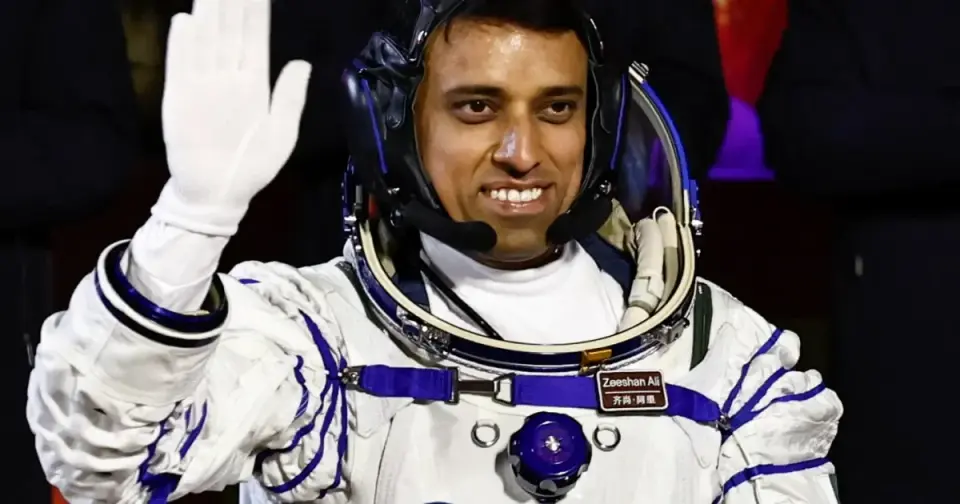
China successfully launched the Shenzhou-24 spacecraft on November 25, 2026, carrying Pakistani astronaut Muhammad Zeeshan Ali to the Tiangong space station. This marks the first time a foreign national has visited China’s orbital laboratory. Ali, a 40-year-old former Pakistan Air Force pilot, flew alongside Chinese astronauts Tang Hongbo and Wu Yi. The mission, stemming from a 2025 bilateral agreement, includes over 90 scientific experiments. Ali will conduct a short-term mission involving a cyanobacteria experiment before returning to Earth, while the Chinese crew remains for six months. The launch was celebrated as a major diplomatic milestone, with Pakistani officials describing it as a source of national pride and a step toward future lunar cooperation.
Key points
- The Shenzhou-24 spacecraft launched from the Jiuquan Satellite Launch Center in northwest China on November 25, 2026, at 00:18 GMT, carrying three astronauts: Pakistani national Muhammad Zeeshan Ali, Chinese commander Tang Hongbo, and flight engineer Wu Yi.
- This is the first time a foreign crew member has visited China’s Tiangong space station, marking a historic milestone for international participation in China’s manned space program.
- Muhammad Zeeshan Ali, a 40-year-old former Pakistan Air Force pilot, will conduct a short-term mission involving a photosynthetic cyanobacteria experiment before returning to Earth aboard the Shenzhou-23 spacecraft.
- Chinese astronauts Tang Hongbo and Wu Yi are expected to remain aboard Tiangong for six months, with Tang Hongbo becoming the first person to visit the station three times.
- The mission is part of a spaceflight cooperation agreement signed by China and Pakistan in February 2025, which included over 90 scientific experiments and technology tests.
- Pakistani Prime Minister Shehbaz Sharif described the mission as a source of national pride and an inspiration for Pakistani youth, while SUPARCO chairman Muhammad Yousaf Khan stated Pakistan aims to reach the moon by 2035, starting with a lunar rover in 2028.
Background
China and Pakistan signed a spaceflight cooperation agreement in February 2025, paving the way for Ali’s mission. Pakistan selected two astronaut candidates who traveled to China for training. The Shenzhou-24 mission is China’s 18th crewed spaceflight and 12th astronaut mission to Tiangong, a three-module orbital lab completed in late 2022. The launch followed a period of increased public interest in space in Pakistan, with amateur astronomy groups like PakAstronomers gaining prominence.
How outlets are covering it
Al Jazeera emphasized the emotional and cultural impact of the launch in Pakistan, describing how students and stargazers gathered at SUPARCO’s auditorium before dawn to watch the launch, with many expressing a sense of national pride and inspiration. AP News focused on the diplomatic significance, highlighting the joint flight as a milestone in China-Pakistan relations and noting the inclusion of over 90 scientific experiments. Space.com provided technical details, noting that Ali is flying as a payload specialist and that the mission marks the first time China has launched a foreign national to space. The Guardian’s coverage was primarily photographic, capturing the launch and the reactions in Islamabad, but did not provide extensive textual analysis. All sources agree on the core facts of the launch and docking, but differ in emphasis: Al Jazeera on the human and cultural aspect, AP on diplomacy, and Space.com on technical and historical context.
Why it matters
The launch of Pakistan’s first astronaut to China’s Tiangong space station marks a significant milestone in international space cooperation, particularly for developing nations. It demonstrates China’s strategy of using space collaboration to strengthen ties with countries in the Global South, potentially rivaling the United States in space diplomacy. For Pakistan, the mission is a source of national pride and a step toward future space ambitions, including a lunar rover by 2028 and a moon landing by 2035. The mission also highlights the growing role of international partnerships in advancing space exploration, with Ali’s short-term mission serving as a precursor to more extensive joint efforts.
What to watch
Muhammad Zeeshan Ali is expected to return to Earth aboard the Shenzhou-23 spacecraft after a short-term mission of about one week, while Chinese astronauts Tang Hongbo and Wu Yi remain aboard Tiangong for six months. Pakistan aims to launch a lunar rover in 2028 as part of its goal to reach the moon by 2035. China is preparing for its first crewed lunar landing by 2030, and the success of this mission may pave the way for further international cooperation in space, including potential joint missions to the Moon and Mars.
- From stargazing to space: Pakistan watches its first astronaut take flight Al Jazeera
- Pakistani pilot to become first foreigner to fly to China's space station Reuters
- China launches Shenzhou 24 spacecraft carrying 2 Chinese and 1 Pakistani astronaut AP News
- Pakistan’s first astronaut and golden light: photos of the day – Wednesday The Guardian
- China launches Pakistani astronaut to Tiangong space station, its 1st international visitor, alongside Shenzhou-24 crew (video) Space
Want the full story? Read the original reporting
Read on Al Jazeera