
Ukraine's 'Vivaldi' Offensive Captures 250 Russian Troops via Drone and 'Trojan' Vehicle Tactics
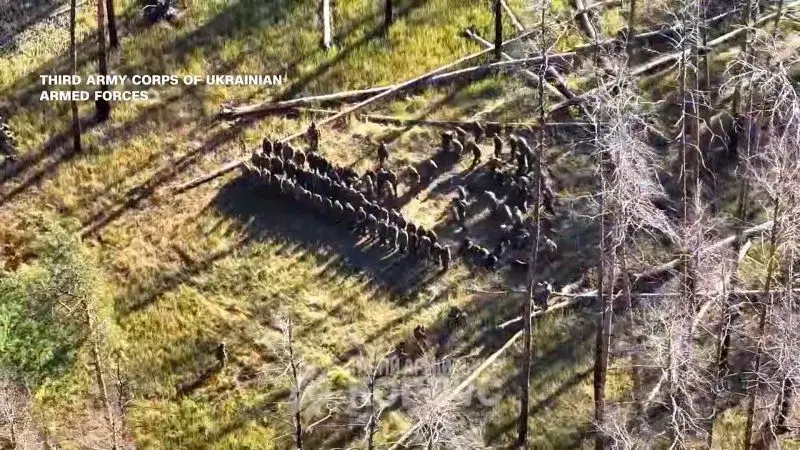
Ukraine’s Third Army Corps has claimed the capture of over 250 Russian soldiers during 'Operation Vivaldi,' a counteroffensive in the Donbas region. The operation utilized airdropped ground robots and explosive-laden 'Trojan' armored vehicles to breach Russian lines. Captured Russian troops reported severe supply shortages, including drinking urine and eating bark, after being abandoned by commanders. While Kyiv cites significant territorial gains and casualties, Russian military bloggers acknowledge logistical failures but dispute the scale of the defeat.
Key points
- Ukraine’s Third Army Corps, led by Brig. Gen. Andriy Biletskyi, reports capturing over 250 Russian soldiers, including officers and specialists, during the third phase of Operation Vivaldi.
- The offensive employed innovative tactics, including airdropping heavy-gun-equipped ground robots more than 10 kilometers behind enemy lines and using Soviet-era armored personnel carriers stuffed with explosives as 'Trojan' kamikaze vehicles.
- Captured Russian soldiers stated they surrendered due to extreme starvation, dehydration, and lack of communication, claiming they had to drink their own urine and eat tree bark after being abandoned by their commanders.
- Ukrainian officials claim the operation reclaimed 176 square kilometers of territory and resulted in over 5,000 Russian casualties, though the Institute for the Study of War (ISW) estimates slightly lower figures for territorial gain.
- Russian military bloggers have acknowledged severe logistical and communication failures in the Lyman sector, confirming reports of supply shortages and command deception, though they dispute the official casualty numbers.
Background
Operation Vivaldi began in May 2026 as a counteroffensive in the northern Donetsk region, specifically targeting the area around Lyman. Previous phases of the operation had already seen significant Ukrainian advances, with the third phase alone reclaiming 51 square kilometers. This operation follows a period of steady Russian gains in the Donbas, which Ukrainian forces have now reversed. The use of autonomous ground vehicles marks a shift in Ukrainian tactics, moving beyond aerial drones to include land-based robotic systems that can operate in all weather conditions and carry larger payloads.
How outlets are covering it
CNN and The Kyiv Independent emphasize the humanitarian aspect of the Russian surrender, highlighting testimonies from prisoners who described drinking urine and eating bark due to abandonment by their commanders. Interfax-Ukraine focuses on the tactical innovation, noting that captured troops are increasingly specialized personnel like UAV pilots and electronic warfare specialists rather than infantry. While Ukrainian sources claim 5,000 Russian casualties and 176 square kilometers of reclaimed territory, the ISW estimates that Russia lost 256 square kilometers in September but only seized 175, with Ukraine recapturing 150 square kilometers. Russian military bloggers, such as 'Rybar' and 'Management Speaks,' confirm the logistical collapse and communication failures but criticize the Russian leadership for concealing the extent of the defeat, contrasting with Ukrainian claims of a decisive victory.
Why it matters
The success of Operation Vivaldi demonstrates Ukraine’s ability to adapt to the modern battlefield using technology to offset manpower disadvantages. The capture of 250 troops and the reclamation of significant territory in the Donbas could slow Russian advances in the region, potentially altering the timeline for Russian control of the area. The reported logistical failures and command deception within the Russian military may undermine morale and operational effectiveness, while the use of autonomous ground vehicles sets a precedent for future warfare in the conflict.
What to watch
Ukrainian forces may continue to expand the gains from Operation Vivaldi, potentially targeting further Russian positions in the Donbas. Russian military leadership may face increased pressure to address logistical and communication failures, potentially leading to changes in command structure or strategy. The use of autonomous ground vehicles and 'Trojan' armored vehicles may become more prevalent in Ukrainian operations, influencing the tactics of both sides. International observers will monitor the impact of these developments on the broader conflict and the potential for further Ukrainian counteroffensives.
- Ukraine says it forced 250 Russian soldiers to surrender in daring operation CNN
- Russian soldiers 'drink own urine and eat bark' as Putin's war machine collapses Daily Star
- Biletskyi spoke with Russian prisoners: "You’ve drawn lucky ticket. In two months’ time, it’ll be hell for you lot here". VIDEO Цензор.НЕТ
- Russian soldiers 'had to drink urine to survive' after being abandoned by commanders, POWs say The Kyiv Independent
- Third Army Corps releases testimonies of Russians captured during operation Vivaldi Interfax-Ukraine
Want the full story? Read the original reporting
Read on CNN