Tag

Ai Memory

All articles tagged with #ai memory

Micron Stock Could Reach $3,500 by 2030 If AI Memory Boom Plays Out
finance1 day ago

Micron Stock Could Reach $3,500 by 2030 If AI Memory Boom Plays Out

Motley Fool argues Micron could benefit as memory becomes a key AI infrastructure constraint, supported by long-term contracts and smarter capital allocation. The article outlines 2030 scenarios: EPS of $250 with a forward P/E of 14 implies about $3,500 a share (upside case), EPS of $160 with a P/E of 10 implies about $1,600 (base case), and EPS of $100 with a P/E of 8 implies about $800 (downside). The base case suggests roughly 67% upside from current levels, though the memory cycle is volatile and risk remains; the piece also promotes Stock Advisor picks.

Micron MU Stock: AI-Memory Contracts Create Long-Term Upside
business1 day ago

Micron MU Stock: AI-Memory Contracts Create Long-Term Upside

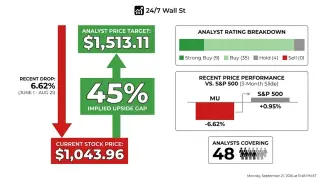
A 24/7 Wall St. piece argues Micron Technology (MU) is a premier AI-memory play, supported by roughly $100 billion in take-or-pay AI-memory revenue contracts through 2030, and very high Core Data Center margins that set MU apart from rivals. The stock is portrayed as attractively valued on forward earnings given the contracted revenue and strong cash flow, with a shareholder-friendly setup (dividends and buybacks) and significant upside if AI-memory demand remains robust beyond 2027, though memory-cycle risk remains a consideration.

Train Your AI, Not Your Attic: Five Memory Tweaks to Make ChatGPT a Real Assistant
technology23 days ago

Train Your AI, Not Your Attic: Five Memory Tweaks to Make ChatGPT a Real Assistant

In a Tom’s Guide feature, Amanda Caswell explains that ChatGPT’s memory is about persistent context, not a random dump of facts, and shares five practical tweaks to make memory truly useful: prune outdated memories to eliminate conflicts, save enduring preferences and long-running projects rather than static facts, rely on memory to anchor ongoing tasks so conversations stay cohesive, use temporary chats to start fresh when exploring new topics, and continuously train the model by giving precise feedback and concrete memory prompts (for example, “remember that I prefer concise answers”). These steps can boost efficiency and make ChatGPT act more like a proactive assistant.

SK Hynix’s booming profits fail to ease AI-spending concerns
finance27 days ago

SK Hynix’s booming profits fail to ease AI-spending concerns

SK Hynix posted a record Q2 operating profit up 557% year over year but fell short of lofty expectations, fueling investor concerns about whether AI-driven memory spending can sustain its rapid pace; the company said it will raise 2026 capex by about 50% to at least $31 billion to expand AI memory production, prompting price-target cuts from Barclays and Susquehanna as chip stocks drop on oversupply fears ahead of results from Microsoft, Amazon and Meta and amid ongoing rate worries.

AI memory race: Can SK Hynix outpace Micron in the AI boom?
business1 month ago

AI memory race: Can SK Hynix outpace Micron in the AI boom?

The AI memory supercycle pits SK Hynix’s leading HBM share and a cheaper valuation against Micron’s strong U.S. manufacturing footprint and earnings momentum. With memory demand expected to run well ahead of supply for years, both face capacity constraints and geopolitics—yet the winner may hinge on who captures more upside from the multi-year cycle: the HBM leader at a discount or the domestic producer at a premium.

MemGhost: A Single Email Inserts Stealthy, Lasting Memories in AI Assistants
technology1 month ago

MemGhost: A Single Email Inserts Stealthy, Lasting Memories in AI Assistants

Researchers reveal MemGhost, an automated attack that can plant a false, durable memory in a personal AI assistant via one crafted email, causing later sessions to be steered by the injected fact. The write targets the agent’s persistent memory and remains hidden from normal chats, with sandbox tests showing high success across OpenClaw (GPT‑5.4) and other agents. The study calls for in‑agent defenses—provenance tagging, prompts before memory writes, and logging/auditing of memory edits, plus separating memory writing from email processing—as there’s no quick fix and real-world abuse remains untested in the wild.

SK Hynix eyes $149 ADR price to back AI-memory expansion in the US
business1 month ago

SK Hynix eyes $149 ADR price to back AI-memory expansion in the US

SK Hynix plans to price its U.S. ADRs at $149 each to raise about $26.5 billion for new factories and equipment to meet surging AI memory demand, with the ADRs to begin trading on Nasdaq as SKHY around July 10; demand reportedly more than seven times the available shares, and underwriters include Bank of America, Citigroup, Goldman Sachs and J.P. Morgan, while the Seoul listing remains primary. The deal could help narrow SK Hynix’s valuation gap with Micron, which trades at a higher forward P/E.

SK Hynix Debuts on Nasdaq as $1 Trillion AI Memory Boom Reshapes the Chip Market
business1 month ago

SK Hynix Debuts on Nasdaq as $1 Trillion AI Memory Boom Reshapes the Chip Market

SK Hynix is set to begin trading on Nasdaq as the AI memory boom propels its market cap toward $1 trillion. The company plans to raise about $29 billion via ADRs to fund U.S. expansion, including a $4 billion Indiana facility for advanced packaging and potential CHIPS Act support, while continuing to expand memory production (HBM, RAM, NAND) in Korea. Nvidia is a major customer in the high-bandwidth memory space, and SK Hynix aims to lock in long-term demand through contracts amid a volatile memory cycle. Analysts foresee revenue growth into 2026, but investors weigh the sector’s cyclical risks against AI-driven demand.

SK Hynix Eyes $29B Nasdaq IPO to Lead AI Memory Boom
business1 month ago

SK Hynix Eyes $29B Nasdaq IPO to Lead AI Memory Boom

SK Hynix is planning a $29 billion Nasdaq IPO, potentially the largest ever by a foreign company in the US, to give investors direct exposure to the AI memory cycle as high-bandwidth memory demand heats up. The move could narrow SK Hynix’s valuation gap with Micron but faces risks from the memory sector’s boom‑and‑bust dynamics, heavy capacity spending, and potential supply glut.

Trump’s Micron Praise Fails to Move Markets as Memory Stocks Slip
business1 month ago

Trump’s Micron Praise Fails to Move Markets as Memory Stocks Slip

Trump praised Micron on Truth Social, but MU slid about 10% on the day amid sector-wide profit-taking after a massive run, as investors reset positions rather than chase headlines. Micron beat Q3 results (revenue about $41.46B, non-GAAP EPS $25.11, gross margin 84.6%) and guided Q4 to roughly $50B revenue and $31 EPS, supported by 16 Strategic Customer Agreements targeting ~$100B in floor-price revenue and about $22B in deposits. Insider selling of $32.7M added to the pullback, underscoring that endorsements rarely move stocks when demand has already priced in perfection and memory names remain under pressure alongside broader AI memory demand themes.

Micron's AI Memory Boom Under Earnings Spotlight
business2 months ago

Micron's AI Memory Boom Under Earnings Spotlight

Micron Technology heads into its upcoming earnings with investors watching whether the AI memory boom can sustain momentum into 2027 and beyond. Analysts forecast about $35.25 billion in revenue and $20.28 per-share for Q3, marking a roughly 279% year-over-year jump, driven by strong DRAM pricing, tight industry capacity, and robust AI demand; key focus will be on DRAM/NAND pricing and capacity commitments for 2027–28 to gauge the durability of the AI memory upswing.

Micron Q3 Preview: AI Fueling Higher Revenue and Margin Expectations
business2 months ago

Micron Q3 Preview: AI Fueling Higher Revenue and Margin Expectations

Micron Technology is set to report fiscal Q3 results on June 24, with analysts eyeing about $35.4 billion in revenue and roughly $20.40 per share, up from prior guidance of around $33.5 billion and $19.15. The Street remains bullish as AI infrastructure demand drives high-bandwidth memory (HBM) shipments and pricing, supported by expectations of an ~81% gross margin. Investors will scrutinize whether Micron’s guidance for fiscal 2027 sustains growth amid tight memory supply across DRAM and NAND.