Samsung Electronics reported record Q3 revenue and operating profit driven by AI memory demand, but shares fell 6% as net profit missed estimates due to financing losses and mobile unit deficits.
SK Hynix reported record third-quarter revenue and operating profit, driven by surging demand for high-bandwidth memory (HBM) used in AI systems. The company announced a massive shareholder return plan, boosting its US-listed shares by 8% and lifting peers like Micron and SanDisk. While net profit missed analyst expectations, the results confirm a sustained memory shortage through 2027.
SK Hynix reported record third-quarter operating profit of 83.33 trillion won, beating analyst estimates. The company announced plans to return approximately $75 billion to shareholders through dividends and buybacks. Shares surged over 10% as the firm confirmed strong demand for high-bandwidth memory through 2030.
SK Hynix reported a 632% surge in operating profit to $62.7 billion, driven by AI data center demand and HBM4 shipments. The company expects the memory shortage to last until 2030 and is returning $75.2 billion to shareholders.
SK Hynix reported record third-quarter operating profit of 83.33 trillion won, beating analyst estimates by 8.6%, driven by surging AI memory demand. The company announced 100 trillion won in shareholder returns and expects HBM4 to become the mainstream product in Q4.
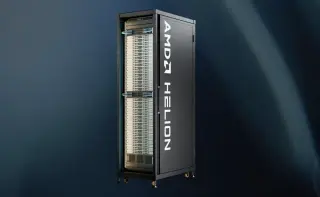
AMD has introduced Helion, an open rack server blueprint designed for agentic AI workloads. The system offers flexible configurations, including a CPU-only model with up to 32,768 Zen 6 'Venice' cores and an all-in-one setup integrating EPYC CPUs with MI350P GPUs. Mass production of the related Helios rack, featuring 72 MI455X accelerators, began in July 2026, with volume shipments expected in Q4 2026. The initiative aims to compete with Nvidia in enterprise AI infrastructure, though supply constraints for HBM4 memory remain a critical bottleneck.
Nvidia is approaching a key technical breakout level, while investors await Micron’s September 30 earnings to gauge the strength of the AI memory cycle. Recent supply constraints and pricing hikes suggest Micron may benefit from tight memory markets, despite its lower valuation compared to Nvidia.
Micron Technology is set to report fiscal Q4 2026 earnings on September 30, with analysts expecting revenue to surge 345% to $50.42 billion and EPS to reach $31.14. The company recently posted record non-GAAP gross margins of 84.9% in Q3, driven by strong conventional memory prices. However, investors are watching whether this margin boom can sustain as Micron ramps up HBM4 production to compete with Samsung and SK hynix, while also managing strategic customer agreements that may cap future pricing.
Micron Technology is set to report earnings on September 30, 2026, after a massive 247% year-to-date stock surge. The company reported $41.46 billion in Q3 revenue and $25.11 in non-GAAP EPS, driven by AI demand. Analysts remain overwhelmingly bullish, with 92% rating the stock a buy, though shares have recently pulled back as investors digest the results.
Micron Technology is undergoing a structural shift from a cyclical memory manufacturer to a company with contracted, long-term revenue. Analysts and investors highlight 16 take-or-pay agreements running through 2030, which lock in approximately $100 billion in minimum revenue. This stability, combined with leadership in High Bandwidth Memory (HBM4) and a fortress balance sheet, has driven the stock up over 700% in the past year. Despite this surge, the stock trades at a low forward earnings multiple, leading some to predict prices could exceed $2,000 by the end of 2027.
Micron Technology is breaking its historical boom-bust cycle through long-term take-or-pay contracts, securing roughly $100 billion in minimum revenue through 2030. Despite a recent 13% stock decline, the company reported record margins and cash flow, positioning it as a dominant player in AI-driven memory demand.
Micron’s 16 Strategic Customer Agreements through 2030 lock in roughly $100B of minimum revenue with floor margins, backed by about $22B in deposits, signaling a contract-backed shift in the memory cycle; the June quarter posted $41.46B revenue, 84.6% gross margin, and $18.3B free cash flow, with guidance for $50B Q4 revenue and $31 EPS, while the stock trades near 6x forward earnings with about $24B in net cash. The bull thesis rests on sustained AI data-center demand keeping memory demand tight beyond 2027, justifying ongoing buying of MU, though risks include customer concentration in HBM4 and a large capex cycle.
Micron Technology has locked in approximately $100 billion in minimum revenue through 16 strategic customer agreements, creating a financial floor that protects against memory price crashes. While these take-or-pay contracts ensure high margins during downturns, they also cap upside potential if market prices surge further. The stock has surged nearly 700% in the past year, driven by AI demand for HBM4 memory, but faces risks from high capital expenditure and insider selling.
Micron Technology has surged 665% in a year as high-bandwidth memory becomes a critical AI component. The company recently reported a fiscal Q3 revenue beat of 17.6% and locked in approximately $100 billion in guaranteed revenue through 16 strategic customer agreements. While bulls cite a low 6x forward P/E compared to NVIDIA's 44x trailing multiple, bears point to $27 billion in capital expenditure and insider selling as signs of a cyclical peak.