
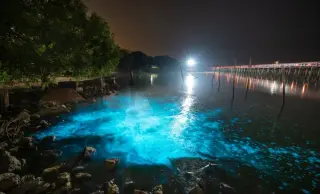
On-Demand Bioluminescent Algae Could Light Robots and Rooms
Researchers at CU Boulder developed a method to trigger sustained bioluminescence in the marine alga Pyrocystis lunula using chemical cues (acidic or basic solutions), enabling light output for up to 25 minutes and embedding the cells in sodium alginate hydrogels via 3D printing to form stable shapes that glow for weeks. Acid-triggered light stays localized in scintillons and, when combined with compressive loading, yields more light; acid-conditioned constructs retained about 75% of luminescent activity after four weeks, while base-treated cells declined due to membrane degradation. The team demonstrated glow across printed forms and envisions applications in biosensing and autonomous lighting for soft robots in environments like deep sea or space, with the algae consuming CO2 during operation. The work was published in Science Advances on May 6, 2026.