Phage protein Gp0.4 hijacks FtsZ to unlock bacterial immunity via CapRelEbc
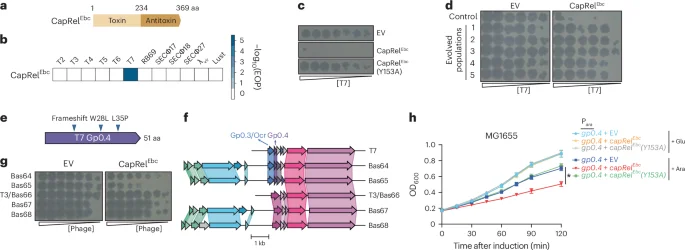
CapRelEbc, a fused toxin–antitoxin system in E. coli, is activated during T7 phage infection only when the phage protein Gp0.4 binds to monomeric FtsZ, forming a Gp0.4–FtsZ–CapRelEbc ternary complex. Gp0.4 inhibits FtsZ polymerization, blocking cell division, and this FtsZ–Gp0.4 complex relieves CapRelEbc auto-inhibition to enable its toxin activity, which pyrophosphorylates tRNAs and halts translation to restrict phage replication. Activation requires FtsZ; phage escape mutants map to Gp0.4 (or FtsZ interaction surfaces) that disrupt this activation. The study uses yeast two-hybrid, ITC, HDX-MS, in vitro translation, and AlphaFold modeling to support a tripartite activation mechanism, illustrating how host factors contribute to bacterial innate immunity.”,