Tag

Christof Koch

All articles tagged with #christof koch

Consciousness Could Be Universal, Not Brain-Born, Says Neuroscientist
science7 days ago

Consciousness Could Be Universal, Not Brain-Born, Says Neuroscientist

Prominent neuroscientist Christof Koch argues that consciousness may be a fundamental aspect of reality rather than solely produced by the brain, challenging the long-held brain-centric view. In an unpublished ScienceAlert essay, he calls for rethinking baseline assumptions, exploring a mind-at-large, and translating these ideas into empirically testable hypotheses about consciousness.
Consciousness at the Core: A Scientist Argues Reality Is Mind-First
science8 days ago

Consciousness at the Core: A Scientist Argues Reality Is Mind-First

Renowned neuroscientist Christof Koch argues consciousness is a fundamental aspect of reality, not produced by brain activity, highlighting analytic idealism, panpsychism, and IIT as alternatives to materialism; the brain may act as a filter for a universal field of awareness, with implications for AI and future testing, inspired in part by Koch's personal experiences and a long-running bet with David Chalmers.

"Insights on Consciousness from Neuroscientist Christof Koch"
science2 years ago

"Insights on Consciousness from Neuroscientist Christof Koch"

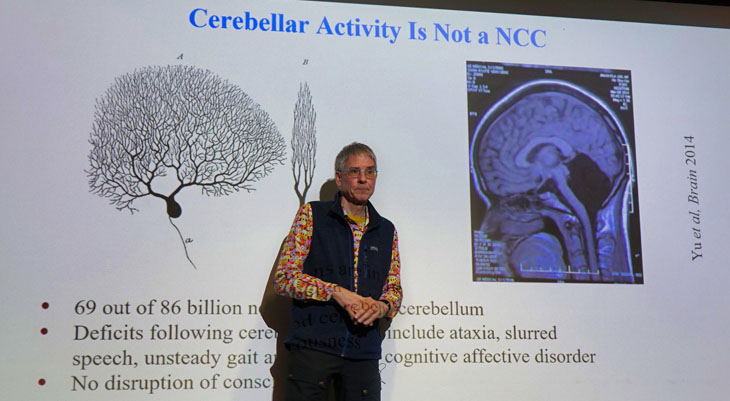
Famed neuroscientist Christof Koch spoke at UC Santa Barbara about consciousness, emphasizing the challenges of studying it and the importance of Integrated Information Theory (IIT). He discussed the neural correlates of consciousness, the hard problem of consciousness, and the limitations of functionalism. Koch also highlighted the potential of psychedelics in understanding consciousness and his interest in their therapeutic value, rapid impact on conscious experience, and potential to reveal truths about existence.

"Neuroscientist's Shift on Physical Consciousness View"
science-and-philosophy2 years ago

"Neuroscientist's Shift on Physical Consciousness View"

Neuroscientist Christof Koch, a proponent of physicalism, now suggests that consciousness cannot be explained solely through physical processes and requires an additional postulation of "experience." He argues for a new understanding of consciousness and the mind, emphasizing the need for better metaphysics and philosophy. Koch also delves into the challenges of defining consciousness, suggesting that it may be beyond linguistic explanation and closer to us than words can convey. This shift in perspective prompts a reevaluation of the nature of consciousness and reality itself.