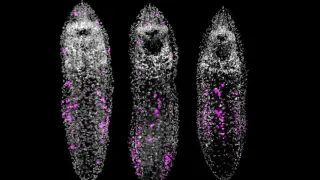
Overfed Tiny Flatworms Grow Chains of Cloned Heads
University of Warsaw researchers showed that feeding abundant prey to four freshwater Stenostomum flatworm species triggers paratomy: developing heads form before earlier clones detach, producing temporary chains of 4–5 zooids connected head-to-tail (paracolonies). The effect, driven by overlapping reproductive cycles, becomes more pronounced with more food. Chains are not permanent and worms separate as heads finish developing; the study is a bioRxiv preprint (not peer-reviewed). While some related flatworms form permanent chains, evidence for a clear advantage or shared digestion in these chains is limited, and ecological implications remain unclear. Experimental results suggest the phenomenon is reproducible and strongly influenced by nutrition.