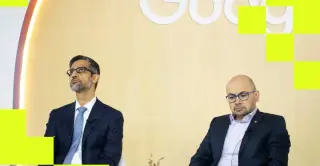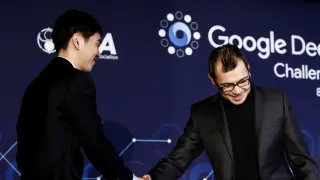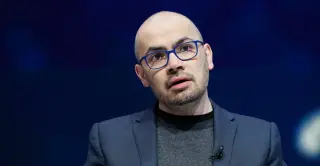
Google DeepMind CEO Demis Hassabis advocates a US-led global AI watchdog that can pre-review frontier models and coordinate an industry-wide slowdown if they are judged too risky to deploy, arguing that global standards are urgently needed as AI approaches AGI.
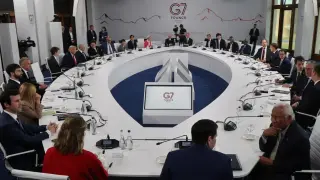
At the G7 summit, AI executives from OpenAI, Anthropic and Google DeepMind joined world leaders as peers, urging democracies to coordinate on global AI standards, testing and risk analysis while stressing that AI labs should not wield unchecked power; the group frames AI as a strategic asset requiring international cooperation and governance to ensure broad benefits and avoid fragmentation.
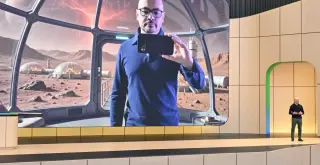
During Google I/O 2026, Demis Hassabis described the moment as the foothills of the singularity and unveiled Gemini for Science, a suite of tools in Google Labs and Antigravity aimed at accelerating scientific research and drug discovery, as part of Google's push toward AGI; Hassabis has previously said there’s a 50% chance of AGI by 2030, though he cautioned that it has not arrived yet.
Former Google engineer Steve Yegge publicly claimed Google’s internal AI adoption lags, alleging a two-tier system with DeepMind’s Claude usage while others rely on in-house tools; Demis Hassabis publicly dismissed the claim as false and clickbait, prompting further pushback from Google staff and fueling a heated debate over how broadly Google is actually using AI internally.
DeepMind chief Demis Hassabis warned that AI investment looks bubble-like, urging realistic expectations about near-term returns while acknowledging the technology's long-term potential.
Demis Hassabis, CEO of Google's DeepMind, emphasizes that 'learning how to learn' will be the most crucial skill for the next generation due to rapid AI advancements, including the potential arrival of artificial general intelligence within a decade, which will necessitate continuous skill development and adaptation.
Google DeepMind CEO Demis Hassabis states that the main obstacle to achieving full artificial general intelligence (AGI) is AI's lack of consistency, as current models can excel in complex tasks like math competitions but still make simple errors, highlighting the need for improved reasoning, planning, and testing to overcome this uneven performance.
Google DeepMind CEO Demis Hassabis states that the main obstacle preventing AI from achieving artificial general intelligence (AGI) is its lack of consistency, particularly in reasoning and memory, despite advancements like Google's Gemini models that can excel in complex tasks but still make simple mistakes. Improving AI's reliability and developing better testing benchmarks are crucial steps forward.
Demis Hassabis, CEO of DeepMind and a key figure in Google's AI efforts, is increasingly central to Google's AI strategy, potentially positioning him as a future CEO. His leadership has evolved from maintaining independence for DeepMind to integrating it more deeply into Google's operations, amid intense competition in AI development, especially against rivals like OpenAI and China. Despite his scientific focus and achievements, including a Nobel Prize, Hassabis faces the challenge of balancing innovation with corporate and ethical considerations as he pushes toward artificial general intelligence.
Demis Hassabis, CEO of Google DeepMind, predicts AI will create new valuable jobs and transform the workforce more significantly than the Industrial Revolution. He emphasizes the importance of studying STEM subjects to understand AI systems and encourages experimenting with AI tools to harness their potential. Hassabis believes future generations will be 'AI native' and that AI will supercharge technically savvy individuals, despite current disruptions in the job market.
DeepMind's Demis Hassabis warns that the huge funding in AI has led to hype and "grifting," with companies overpromising and underdelivering, potentially damaging the reputation of the entire field.
Demis Hassabis, the CEO of Google DeepMind, discusses the evolution from chatbots to artificial general intelligence (A.G.I.) on the "Hard Fork" podcast, highlighting the challenges and potential of achieving A.G.I. in the future.
Google DeepMind CEO Demis Hassabis is leading the development of a new AI model, Gemini, which is as capable and innovative as OpenAI’s ChatGPT. The new Gemini Pro 1.5 can analyze vast amounts of text, video, and audio, and the company is working on an even more powerful model, Gemini Ultra. Hassabis believes that achieving artificial general intelligence (AGI) will require several innovations in addition to scale, and that AI companies will increasingly focus on developing agent-like systems for tasks and planning. He also emphasizes the need for caution and safety measures as AI systems become more active and capable.
Google's AI division, DeepMind, has announced the launch of Gemini, a new AI model that aims to revolutionize the field of artificial intelligence. Gemini is described as a "multimodal" model, capable of processing information in the form of text, audio, images, and video. It represents a significant step forward in creating AI models inspired by the way humans interact and understand the world through their senses. Gemini outperforms GPT-4, the model behind OpenAI's ChatGPT, on several benchmarks and showcases complex reasoning and the ability to combine information from different modalities. Google is also exploring the integration of Gemini with robotics to enable physical interaction with the world. The company is focused on advancing the reasoning abilities of AI models and is working on safety and responsibility tests for the upcoming release of the most powerful version of Gemini, Ultra.
Elon Musk was reportedly left "speechless" when Demis Hassabis, cofounder of Google DeepMind, pointed out a flaw in Musk's plan to colonize Mars. During a conversation in 2012, Hassabis warned that if AI surpassed human intelligence, it could follow humans to Mars and pose a threat. Musk, who had not considered this possibility, later invested in DeepMind but later criticized the firm's AI capabilities. This incident highlights a hole in Musk's Mars colonization plan, as it fails to address the potential risks of bringing Earthbound problems to another planet.