
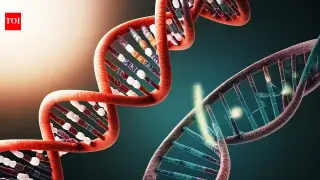
Eight-letter DNA gets read by a bacterial enzyme, doubling the genetic alphabet in the lab
Researchers at UC San Diego showed a naturally occurring bacterial polymerase can accurately read and transcribe DNA containing four natural bases plus four synthetic ones, effectively doubling the genetic alphabet. While demonstrated in vitro, this proof-of-principle expands possibilities for synthetic biology, medicine, and data storage, though adapting the system to living cells will require addressing compatibility and safety challenges.