AI analyzed around 500,000 initiator variants to identify the DNA pattern that marks where genes begin; this initiator appears in roughly 60% of human genes, enabling predictions of how mutations affect gene activity and aiding the design of synthetic promoters to control gene expression.
Scientists studying E. coli’s defense system DRT3 found that the enzyme DRT3b can synthesize a repeating C-A-C-A DNA strand using amino acids in the enzyme as a template, effectively translating protein sequence into DNA without an RNA template, while DRT3a still makes DNA from RNA. The two strands form a double helix and together act as an antiviral defense, with RecBCD normally destroying such DNA; when RecBCD is disabled by viruses, accumulating DRT3 DNA halts bacterial growth to stop the virus. The finding, supported by cryo-EM structures and mutational tests, suggests this amino-acid–templating mechanism may be more widespread in nature.
Belgium’s Prince Laurent has legally recognized Clement Vandenkerckhove, a 26-year-old former Opel car salesman, as his secret son, giving him equal inheritance rights to Laurent’s private estate alongside his half-siblings but without any royal duties, throne rights, or a royal allowance; the revelation followed a TV documentary and echoes past Belgian royal paternity cases.
An 81-year-old man admitted to sexually assaulting and killing American tourist Amy Lopez in Koblenz in 1994 as his murder trial opened; prosecutors say he killed to satisfy sexual urges, DNA linked him, and the decades-old case is headed toward a September verdict.
Penn State researchers combined synthetic, silver-doped DNA with perovskite to create a bio-hybrid memristor that stores data with far less energy—about 100 times lower power—while achieving higher storage density than traditional memory, a breakthrough poised to enable neuromorphic, brain-like computing. The device operates at voltages below 0.1 V and remains stable under high temperatures and for weeks at room temperature, highlighting a viable path for low-power, high-density memory in future electronics.
About 8% of the human genome comes from ancient retroviruses. A viral gene called syncytin was repurposed to form the placental barrier, and different mammal lineages independently co-opted viral genes to solve the same reproductive problem, showing how ancient infections helped shape our biology.
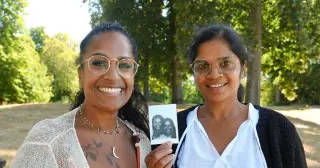
Two women raised in separate Dutch adoptive families after being left as infants in India learned via a MyHeritage DNA test that they are biological sisters, with a 100% match; they had connected as teens in 1996 and have since reunited, forming a close, daily-bonded relationship.
Researchers trained Evo, a genomic AI, on more than 9 trillion nucleotide sequences to learn DNA design rules, then used it to generate about 285 candidate viral genomes; 16 of these synthesized genomes assembled into viable bacteriophages that can infect and reproduce in E. coli, demonstrating AI’s potential to design new organisms while highlighting serious biosafety and governance concerns about applying such methods to pathogens.
A new computational method called TRACE uncovers traces of two unknown archaic human lineages in modern genomes. One African ghost lineage, diverging ~800,000 years ago and interbreeding with Homo sapiens over 50,000 years ago, contributes about 1% of every person’s DNA. A second, “super-archaic” lineage dating to ~1.8 million years ago mixed with Denisovans in Eurasia, with traces most evident in Oceania. Together, these lineages account for roughly 2% of the modern genome and include segments linked to immunity and metabolism, hinting at adaptive value. The study, published in Science on July 30, 2026, showcases how ancestral recombination graph methods can reveal deep ancestry without ancient DNA.
Nearly 48 years after a 15-year-old girl's body was found in a Kern County vineyard in 1978, investigators identified the victim as Michelle Louise Collier through modern DNA analysis and a family member's genealogy data; the case remains open and authorities seek any additional information.
Pima County Sheriff Chris Nanos says the investigation into Nancy Guthrie’s abduction remains active and not cold, noting investigators are sorting through a large volume of DNA and video evidence more than 25 weeks after the Tucson home invasion, as Savannah Guthrie released a new Instagram plea to her mother’s kidnappers; a federal source says Guthrie consulted with law enforcement before releasing the video, and experts caution the case isn’t cold until all leads are exhausted.
A long-running line of research shows fetal cells can persist in a mother's body after pregnancy, including the brain, sometimes as intact cells carrying male DNA; a 2012 study found male DNA in brains of women who had male pregnancies, with a 94-year-old case showing high signal, and later work confirms bidirectional cell traffic and links to autoimmune conditions and tissue repair, though mechanisms are unclear and larger studies in ordinary brain tissue are needed.
A DNA expert testified that blood stains found in the garage of D4vd (David Burke) match Celeste Rivas Hernandez’s blood, linking the slain 14-year-old to the singer’s property as his Los Angeles trial continues; Celeste’s body was found in a vehicle owned by D4vd.
Arlington police arrested real estate agent Mayra Velasquez after genetic genealogy linked a relative's DNA and a discarded fork to a blood droplet at the 2012 stabbing death of Irasema Chavez, solving Arlington's cold-case murder; investigators say cellphone data and the FBI's genetic genealogy program were key to the breakthrough, though motive remains unclear.
Arlington police and the FBI arrested Mayra Velasquez for capital murder in the 2012 stabbing death of Irasema Chavez after investigators used investigative genetic genealogy to connect a DNA sample from the scene to Velasquez. A discarded-trash DNA sample matched Velasquez, leading to the arrest in Hurst; the motive remains unclear, and Velasquez is being held without bond.