
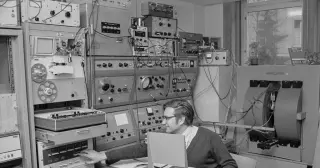
NMR Spectroscopy Evolves: From Nobel-Winning Foundations to Quantum and Medical Frontiers
Nuclear magnetic resonance (NMR) spectroscopy has transformed from a 1930s physics experiment into a cornerstone of chemical analysis, largely due to Richard Ernst’s 1991 Nobel-winning innovations in Fourier transform and 2D NMR. Despite persistent limitations in sensitivity and the need for expensive superconducting magnets, modern advancements in hyperpolarisation, microcoils, and benchtop systems are expanding its utility. Researchers are now applying NMR to study working batteries, corrosion, and lung conditions using xenon-129, while also leveraging its principles for quantum computing, proving the technique remains vital decades after its inception.