
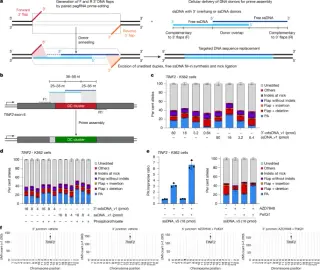
Prime assembly enables in-cell stitching of large DNA segments for targeted genome editing
Nature reports a CRISPR-guided method called prime assembly (PA) that enables in-cell DNA assembly and site-specific integration of medium-to-large DNA fragments using RNA-programmed 3′ flap synthesis. PA works in dividing and non-dividing cells, including primary CD3+ T cells and CD34+ HSPCs, and supports exon recoding, multiple-locus transgene integration (e.g., at AAVS1, IL2RG, TRAC) and megabase-scale rearrangements, with high genome-wide specificity. It accommodates dsDNA and long or split ssDNA donors (up to 12 kb and beyond) and can perform multi-fragment assembly, megabase deletions, inversions, and translocations, sometimes enhanced by end-joining inhibitors. Compared with HDR and other nuclease-based approaches, PA often offers higher precision and broader applicability in non-dividing cells, suggesting a promising platform for therapeutic genome editing and functional genomics in human cells.