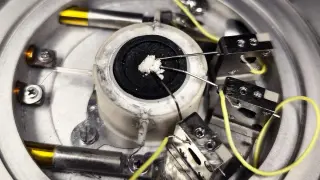
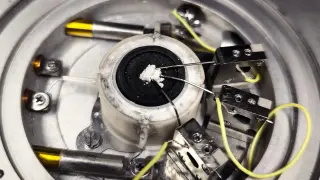
Researchers at UC Berkeley and Lawrence Berkeley National Laboratory have successfully observed the real-time conversion of carbon dioxide into solid graphite using molten-salt electrolysis at 500°C. Published in Nature Communications, the study confirms a two-step reaction pathway involving a peroxide intermediate, allowing scientists to tailor the resulting carbon structure for battery applications without mining.
Scientists at Lawrence Berkeley National Laboratory, UC Berkeley, and Estonia’s National Institute of Chemical Physics and Biophysics have successfully observed the real-time conversion of carbon dioxide into solid carbon using molten-salt electrolysis. Published in Nature Communications, the study reveals a two-stage chemical process where electric current strips oxygen from CO2, depositing pure carbon on a cathode. By engineering heat-resistant lenses, researchers overcame the corrosive nature of 500°C (932°F) salts to capture continuous visual data. The findings demonstrate that varying salt mixtures and electrode materials alters the crystalline structure of the resulting carbon, offering a potential pathway to produce battery-grade graphite from captured industrial emissions. While promising for decarbonizing battery supply chains, the team notes significant engineering hurdles remain, including scaling up production and optimizing energy inputs for industrial viability.