
Berkeley Lab Captures Real-Time Footage of CO2 Turning into Graphite in Molten Salt
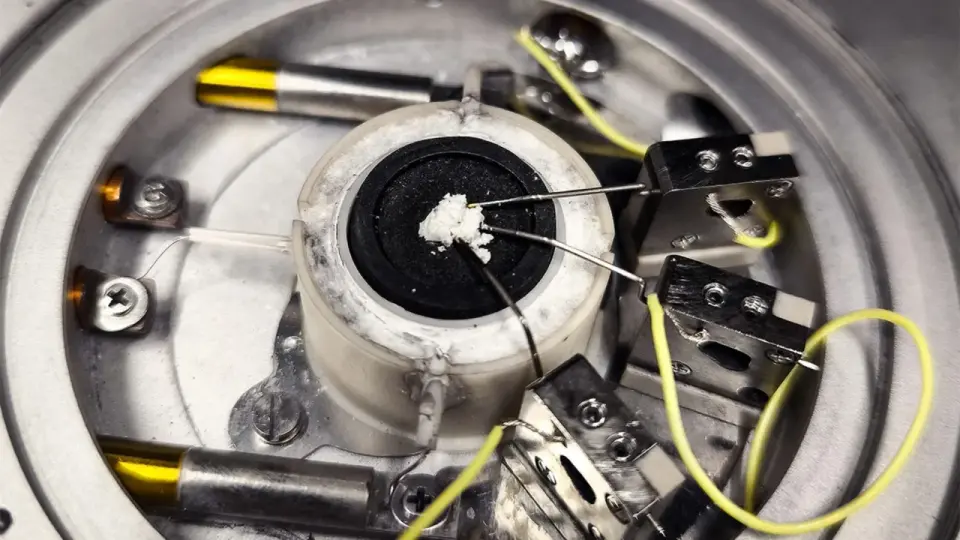
Scientists at Lawrence Berkeley National Laboratory, UC Berkeley, and Estonia’s National Institute of Chemical Physics and Biophysics have successfully observed the real-time conversion of carbon dioxide into solid carbon using molten-salt electrolysis. Published in Nature Communications, the study reveals a two-stage chemical process where electric current strips oxygen from CO2, depositing pure carbon on a cathode. By engineering heat-resistant lenses, researchers overcame the corrosive nature of 500°C (932°F) salts to capture continuous visual data. The findings demonstrate that varying salt mixtures and electrode materials alters the crystalline structure of the resulting carbon, offering a potential pathway to produce battery-grade graphite from captured industrial emissions. While promising for decarbonizing battery supply chains, the team notes significant engineering hurdles remain, including scaling up production and optimizing energy inputs for industrial viability.
Key points
- Real-time microscopy captured CO2 converting to solid carbon in molten salt at 500°C (932°F).
- The conversion occurs in two distinct stages, involving an intermediate chemical state before solid deposition.
- Changing salt chemistries and electrode surfaces alters the geometric arrangement of carbon atoms, allowing for tuning of crystalline structure.
- The research was funded by the Department of Energy’s MINerals for Energy Storage Synthesis (MINES) program.
- Industrial scaling requires solving challenges related to gas flow, heat distribution, and current density across larger electrodes.
Background
This development builds on recent advancements in molten-salt chemistry, such as the 2026 synthesis of colloidal metal-nitride nanocrystals using high-pressure ammonothermal conditions. It also aligns with broader efforts to utilize molten salts for energy applications, including the 2026 approval of molten salt reactor concepts for nuclear-powered cargo ships. These projects highlight the versatility of molten salts in synthesizing critical materials and managing energy systems, though the current graphite synthesis remains a laboratory-scale proof of concept rather than an industrial deployment.
How outlets are covering it
Interesting Engineering emphasizes the potential for this technology to feed directly into EV battery supply chains by producing battery-grade graphite with specific crystalline alignments, highlighting the economic and environmental benefits of using captured emissions. EIN News, citing Lawrence Berkeley National Laboratory, frames the achievement primarily as a breakthrough in observational chemistry, noting that molten salts have historically been difficult to probe due to their harsh, corrosive conditions. While both sources agree on the scientific significance, Interesting Engineering focuses on the end-application for batteries, whereas EIN News highlights the methodological advance in studying reactions within extreme environments. Both acknowledge that the process currently requires high temperatures and further optimization before industrial scaling is possible.
Why it matters
This research offers a potential solution to the critical shortage of battery-grade graphite, a key component in electric vehicle batteries. By converting carbon dioxide into solid carbon, the process could simultaneously reduce industrial emissions and supply essential materials for the energy transition. If scaled, it could decouple graphite production from mining, reducing environmental impact and supply chain vulnerabilities. However, the high energy requirements and engineering challenges of scaling from microscopic cells to industrial reactors remain significant barriers to immediate commercial adoption.
What to watch
Researchers will focus on determining optimal combinations of molten salts, electrode materials, temperatures, and voltages to maximize graphite yield and quality. The next phase involves scaling up the process to produce industrially useful amounts, requiring careful management of gas flow, heat distribution, and current density. Additionally, efforts will be made to lower the operating temperature and use cheaper salts to improve economic viability and enable decentralized production.
Want the full story? Read the original reporting
Read on Interesting Engineering