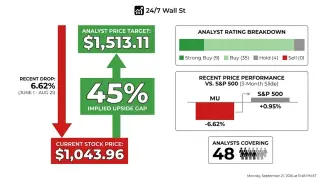
Micron logged a record quarter (revenue $41.46B, adjusted EPS $25.11, gross margin 84.9%) and guided Q4 revenue above estimates, but the stock fell after an initial post-earnings rally as investors worry about memory-cycle dynamics, rising capex from Samsung and SK Hynix, potential shifts in Apple’s sourcing from China, and the risk that peak margins may not persist despite the strong results.
Micron Technology (MU) has fallen about 22% from its June-quarter highs after its strong earnings report, even dipping below pre-earnings levels. Analysts say the AI data-center memory boom remains a driver for the sector, but momentum in these names looks crowded and recent Meta/Apple headlines have added selling pressure. Citiviews the pullback as a buying opportunity, expecting DRAM memory prices to rise and AI-driven demand to support MU’s upside over the longer term.
Analysts argue Micron could surge toward a $2,000 price as AI-driven memory demand tightens supply, long-term customer contracts through 2030 totaling about $100 billion improve visibility and pricing, and MU's record DRAM/NAND revenue supports a valuation some on Wall Street still find attractive. The stock carries a Strong Buy consensus with a high price target, reflecting optimism about sustained AI investment and disciplined memory supply through 2027.
Jim Cramer highlighted Micron’s blowout quarter—$41.5 billion in revenue, $25.11 per share, and an 85% gross margin—arguing that a persistent memory shortage and surging data-center demand are propelling MU’s AI-era growth. He notes MU’s aggressive U.S. investment plan of about $200 billion creating 90,000 jobs, and that the stock remains attractive at under 8x earnings, though he cautions some AI stocks could offer greater upside.
Retail investors view Micron Technology (MU) as the superior AI play versus Space SPAC (SPCX), citing soaring demand for memory chips (DRAM, NAND, HBMs) as hyperscalers expand AI data centers. MU faces a medium-term supply constraint (roughly 50–66% of actual demand meetable) but has multi-year take‑or‑pay contracts with major cloud providers. Memory prices are surging (DRAM up 58–63% QoQ, NAND up 70–75%, SSDs up ~80%), with TrendForce Forecasting elevated pricing to persist beyond 2026, supporting MU’s upside despite cyclical risks.
Micron Technology beat Q3 expectations with $41.46 billion in revenue and $25.11 in earnings per share, guiding about $50 billion in revenue for the next quarter. In response, Deutsche Bank raised its price target to $1,550, while DA Davidson and Cantor Fitzgerald boosted their targets to $2,000, reflecting strong AI memory demand. While the upbeat analyst coverage signals optimism, the article warns that macro factors could still cap gains, even as MU trades near $973.
Micron Technology shattered expectations with fiscal Q3 revenue of $41.5 billion (well above the ~$33.5 billion consensus) and guided for about $50 billion in Q4, driven by unprecedented demand for DRAM and NAND from data-center build-outs and ongoing AI-related spending. With supply tight and prices rising, the stock has jumped roughly 272% since the start of 2026. Management cautions that tight conditions could persist beyond 2027, but analysts still see upside as memory demand remains robust and valuation appears modest relative to forward earnings, despite potential volatility in the shares.
Trump praised Micron on Truth Social, but MU slid about 10% on the day amid sector-wide profit-taking after a massive run, as investors reset positions rather than chase headlines. Micron beat Q3 results (revenue about $41.46B, non-GAAP EPS $25.11, gross margin 84.6%) and guided Q4 to roughly $50B revenue and $31 EPS, supported by 16 Strategic Customer Agreements targeting ~$100B in floor-price revenue and about $22B in deposits. Insider selling of $32.7M added to the pullback, underscoring that endorsements rarely move stocks when demand has already priced in perfection and memory names remain under pressure alongside broader AI memory demand themes.
Micron delivered a blowout quarter with $41.46 billion in revenue (up about 350% year over year) and $25.11 in earnings per share, led by data-center demand. The company also guided to roughly $50 billion in revenue and $31 per share for the current quarter, as strategic customer agreements push revenue visibility higher—16 such deals with 14 showing around $100 billion in five-year revenue potential and $22 billion in cash deposits. In the wake of the report, analysts upgraded Micron to a unanimous Strong Buy, citing strong demand, expanding capacity, and pricing power that could sustain upside beyond a remarkable 800% run over the past year. Risks include potential AI infrastructure spending softening and ongoing capacity constraints that could temper growth if demand slows. Micron trades at about 11x forward earnings with a market cap near $1.3 trillion, leaving investors weighing sustainability of the uptrend against these risks.
Mizuho argues two H2 catalysts could drive Micron and the memory sector: (1) reports that Apple may seek U.S. government approval to source DRAM from CXMT, underscoring industry-wide supply tightness rather than a Micron-specific problem, with MU shifting toward hyperscalers and high-end memory; (2) a multi-decade memory-capacity expansion by SK Hynix, Samsung and Korea’s government—largely political signaling with no immediate capital commitments—while Micron also plans four new memory fabs. The broader demand backdrop and expected HBM pricing strength in 2027 could lift Street EPS for Micron into 2027, with MU’s next earnings cycle in Sept 2026 acting as a near-term trigger.
Micron Technology led a tech-stock rally after a strong fiscal third-quarter report and bullish analyst reactions, with the company signaling stronger AI-related DRAM demand and signing 16 strategic customer agreements. MU jumped about 10%, lifting memory peers like Sandisk, Western Digital and Seagate, while SK Hynix surged in Korea on plans for a U.S. listing and Nvidia edged lower in a broadly mixed market where some tech names dragged while others rose.
Micron Technology’s stock slid about 13% on Tuesday ahead of its upcoming earnings, and options traders are pricing in a large move. Near-the-money June 26 straddles imply roughly a $139 swing by Friday’s close (about 13%), suggesting a post-earnings range near $920 to $1,200. Active trading on both call and put sides, with notable open interest at the $1,050 strike, indicates investors are hedging for a big move in either direction.
Micron Technology (MU) slid over 10% in Tuesday trading ahead of its Q3 results, even as Bank of America hiked its price target by 58% to $1,500, citing a larger semiconductor total addressable market (about $2.7 trillion by 2030) and stronger AI, cloud, and data‑center demand for memory and chips; MU’s strategic partnership with Anthropic and improving automotive/industrial markets underpin the more bullish outlook despite the near‑term pullback.
Needham & Co. boosted its price target on Micron Technology (MU) to $1,550 from $500 and reiterated a Buy rating, arguing firmer memory-market conditions over the past three months with steady demand, healthier pricing and limited new supply. The note says long-term memory demand linked to AI systems could justify higher valuations, with Micron’s upcoming earnings report due June 24 providing a fresh read on whether the backdrop continues to improve.
Micron Technology’s stock jumped past $1,000 amid an AI-driven memory surge, driven by high-bandwidth memory (HBM) and DRAM demand for AI data centers. The piece notes tight HBM supply, multiyear hyperscaler contracts, and a memory market forecast to grow as AI capex stays strong, which could support margins even in a cyclical industry. While the stock’s forward multiple looks appealing relative to peers, risks include faster-than-expected capacity additions and potential softness in AI data-center spending that could compress profits.