
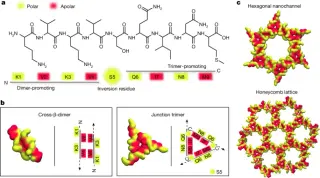
Nine-residue peptides encode hexagonal nanochannel lattices via specific interaction motifs
Researchers have demonstrated that minimal nine-residue peptides can self-assemble into complex, hexagonal nanofibrils with continuous internal channels. By combining a cross-beta dimer, a trimeric junction, and a central inversion residue, these short sequences encode specific lateral and axial interaction motifs. Cryo-electron microscopy reveals that these motifs tile into honeycomb lattices with approximately 5-nm solvent-accessible pores. The study establishes that sequence-encoded amphiphilicity can program long-range supramolecular order without requiring cyclic scaffolds or large pre-organized interfaces, offering a new framework for designing hierarchical peptide architectures.