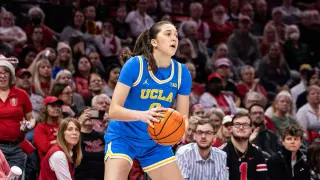
An Ohio judge granted a preliminary injunction allowing 24 current college basketball players to enter the transfer portal and pursue a fifth year under a lawsuit challenging the NCAA's new five-year eligibility model.
An Ohio judge issued a temporary injunction allowing 15 Division I basketball players whose eligibility expired under the NCAA's new five-season rule to return for another season, even as the transfer portal window had closed; the NCAA criticized the ruling and said it will appeal, arguing the decision harms eligible student-athletes and may require congressional action to resolve amid a wave of lawsuits challenging waivers and age-based eligibility changes in college sports.
At Big 12 media day, Brett Yormark dodged a direct answer about Cincinnati’s knowledge of Brendan Sorsby’s gambling in the NCAA probe, prompting the author to demand transparency: if Cincinnati knew and played Sorsby, sanctions should follow; if not, the investigation should be clarified. The NCAA says it received a sportsbook tip (alerted by law enforcement) about Sorsby, while multiple reports and Sorsby’s lawsuit allege Cincinnati knew in 2025. The piece criticizes Yormark’s performative response, questions the tip’s chain of custody, and notes Sorsby’s long gambling history and Cincinnati’s NIL/education defenses and his move to Texas Tech.
Cincinnati coach Scott Satterfield claimed Texas Tech and other programs reached out to Brendan Sorsby’s camp about transferring before the 2025 season ended, alleging tampering. Sorsby’s agent denied prior contact, and Satterfield suggested such tampering is common in the NIL era. Cincinnati says it did not know of any illegal activity by Sorsby, while the NCAA reportedly has investigated Cincinnati regarding Sorsby’s gambling situation.
The NCAA has opened an inquiry into Cincinnati regarding Brendan Sorsby and impermissible wagering, sending a letter of inquiry to the program. Cincinnati says officials were not aware of any wagering and will respond soon, but if the school knew Sorsby’s eligibility could have been affected by his Indiana-era betting, it could face sanctions.
NCAA president Charlie Baker says the association will not change its transgender-athlete rules after the Supreme Court upheld state bans, arguing the policy already aligns with federal standards and that changes would be driven mostly at the state level; the ruling reinforces bans on transgender girls in women’s sports under Title IX, while litigation continues elsewhere, and Baker noted very few NCAA athletes are transgender.
After the Supreme Court upheld state bans on transgender girls in women’s sports, NCAA president Charlie Baker said the NCAA’s national standard for transgender-athlete participation should stay in place and guide school eligibility. The updated policy, adopted after the Trump-era order, allows student-athletes assigned male at birth to participate on women’s teams under defined terms, a point of ongoing debate as critics argue the rules aren’t clear enough and birth-certificate changes vary across states.
Former NCAA basketball standout Kerr Kriisa was arrested by the FBI in Lexington, KY, over an alleged multimillion-dollar fraud scheme tied to his senior year at West Virginia; extradition to WV is expected as federal authorities handle the case. Kriisa played for Arizona, West Virginia, Kentucky and Cincinnati, and was set to compete in The Basketball Tournament before his arrest.
The Supreme Court held that Title IX allows separating teams by biological sex and to exclude transgender women from women’s sports; while no damages were awarded in current suits against the NCAA and Mountain West, the decision could be a turning point for plaintiffs like Riley Gaines and Brooke Slusser in pursuing damages for past opportunities and privacy violations, and it leaves open questions about Title IX's applicability to the NCAA and ongoing briefs as cases proceed.
Ohio State’s 90 scholarship players are affected by the NCAA’s new five-year, age-based eligibility model: the 2026 class now starts with five years of eligibility, redshirts are effectively obsolete under the new rules, and teams can use more players without worrying about long-term eligibility. Fourth-year seniors who would have exhausted in 2027 can return for 2027, and players who hadn’t redshirted gain a fifth year. The article groups remaining eligibility by bucket (seniors, two-year seniors, juniors, sophomores, freshmen). Justyn Martin could still seek a sixth year for a pre-rule injury, though hardship waivers are no longer granted, and several players across buckets may choose to extend their careers into 2027, boosting depth for Ohio State.
The NCAA Division I Cabinet approved the 5-in-5 age-based eligibility model, granting up to five years of eligibility for players who enroll by age 19, a move that creates uncertainty about roster caps, recruiting, and budgets across conferences (notably the Ivy League and Patriot League) and by institution (including service academies). Coaches expect varied impacts and possible reductions in Class of 2028 commitments (roughly 5–10% fewer this fall, with adjustments later) rather than a uniform overhaul. The NIL landscape in lacrosse remains limited and largely donor-driven, while other DI sports policy discussions (e.g., soccer) advance separately. Overall, the exact effects on rosters and recruiting will depend on program and conference choices, and “unanswered questions” abound as schools navigate implementation challenges.
The NCAA cabinet approved allowing players five years to play five seasons (with an age limit), a change coaches like NC State’s Dave Doeren say will end the roster-management leverage created by the 2018 four-game redshirt rule and the post-NIL/transfer portal era. It simplifies planning by keeping more healthy players eligible, potentially altering development timelines for players like MJ Morris and C.J. Bailey, and should broadly ease roster decisions across football (and impact-adjacent sports) while preserving a clear path to degrees.
The NCAA’s new five-year, five-season eligibility rule eliminates redshirting and most waivers, with the clock starting five years after full-time college enrollment or on the student’s 19th birthday, whichever comes first. While 2027 recruits must follow the new rules, current Georgia players can choose the old or new system, potentially granting an extra year to seven on Georgia’s 2026 roster and many other non-redshirt players; others who already exhausted eligibility remain under prior rules. Georgia coach Kirby Smart supported the change, and the team opens 2026 vs. Tennessee State.”
The NCAA Division I FBS Oversight Committee unveiled a plan to shorten the transfer portal notification window to a 10-day span starting the first business day after January 1 (opening the Monday after CFP quarterfinals) from the current January 2–16 window. It also proposes OTA-style offseason workouts: two practice periods totaling 21 on-field practices with each period capped at seven weeks and no period exceeding five weeks, plus a minimum of nine voluntary weeks when activities aren’t allowed. The preseason would permit 21 practices in a 27-day window, lowering total practice days by four due to additional spring/summer opportunities. If approved in August, these changes would take effect January 1, 2027. The 2026 cycle was the first without a spring window; exceptions exist for coaching changes, and other calendar shifts (including a Week 0 start proposal) are under consideration with Cabinet review ongoing.
Fifteen players, including Xavier's Filip Borovicanin and Cincinnati's MJ Collins, filed an Ohio lawsuit seeking an injunction to allow them to play the 2026-27 season under the NCAA's new age-based eligibility model. The suit argues the rule unfairly penalizes seniors who already faced extended eligibility due to Covid waivers, and it notes the NCAA plans to codify a five-year eligibility rule with a final vote imminent. The plaintiffs hope for immediate relief to sign scholarships/NIL deals; current athletes with remaining eligibility can choose the new model or the previous rules, while 2027 recruits will be subject to age-based eligibility only.