Tag

Nuclear Clocks

All articles tagged with #nuclear clocks

China’s UV Crystal Aims to Enable GPS-Free Navigation for Submarines and Missiles
military1 month ago

China’s UV Crystal Aims to Enable GPS-Free Navigation for Submarines and Missiles

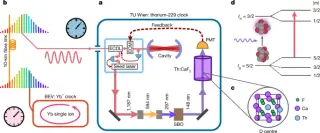
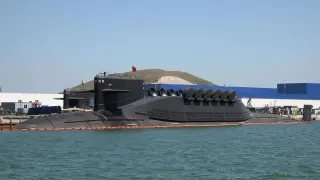
Chinese researchers say a fluorinated borate crystal can convert laser light to 145.2 nm ultraviolet, enabling extremely precise thorium-229–based nuclear clocks that could support GPS-free navigation for submarines, missiles, and spacecraft. If perfected, this could improve “dead reckoning” navigation and reduce reliance on GPS, though practical deployment remains uncertain and the technology is far from ready.

Revolutionary Scandium-based Atomic Clocks Ensure Unprecedented Precision for Eons
science-and-technology2 years ago

Revolutionary Scandium-based Atomic Clocks Ensure Unprecedented Precision for Eons

Scientists have identified scandium as a promising element for the development of nuclear clocks, which could offer accuracy up to 1 second in 300 billion years. Unlike atomic clocks that rely on electron shell oscillation, nuclear clocks use the oscillation of the atomic nucleus for enhanced timekeeping. Scandium's atomic resonances are more acute than those of electrons, making it a potential candidate. However, generating the necessary oscillation in scandium requires X-rays with high energy levels. The researchers demonstrated a resonant width of only 1.4 femtoelectronvolts, suggesting an accuracy of 1:10,000,000,000,000. This advancement could have applications in extreme metrology, nuclear clock technology, and ultra-high-precision spectroscopy.

"Breakthrough in Nuclear Time Race: Scientists Achieve Crucial Advancement"
science-and-technology2 years ago

"Breakthrough in Nuclear Time Race: Scientists Achieve Crucial Advancement"

Scientists, including researchers from LMU, have made significant progress in the development of nuclear clocks, which could provide a more precise measurement of time and offer insights into fundamental forces of the universe. By accurately characterizing the excitation energy of thorium-229, the element that could be used as the timekeeping component in nuclear clocks, the researchers have taken a critical step towards realizing this technology. Nuclear clocks could open up new research fields that cannot be explored with atomic clocks and have potential practical applications, such as detecting changes in the Earth's gravitational field. The first prototypes of nuclear clocks could be developed within the next decade.