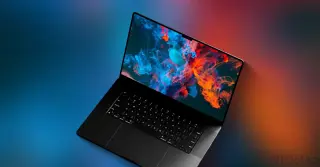
Rumors claim Apple will add Samsung's Privacy Display OLED panels to the upcoming M6 Pro and M6 Max MacBook Pro, bringing the feature months earlier than previously forecast; only these models will get OLED and Privacy Display tech, with cooling upgrades and a possible 'MacBook Ultra' branding.
A hobbyist built a Cyberpunk-inspired jacket with four flexible OLED panels mounted in the collar, driven by two Raspberry Pi 4s (two screens per Pi) using a GPIO-based sync, all housed in a 3D-printed frame to protect the displays; the result recreates the game’s jacket look and demonstrates wearable multi-display tech, though it remains a prototype rather than practical mass-market gear.
RTINGS’s review praises the ASUS ROG Swift OLED PG34WCDN as a premium 34-inch ultrawide gaming monitor with a curved 3440x1440 panel, a blistering 360 Hz refresh rate, and a fifth-gen QD‑OLED RGB Stripe subpixel layout that improves text clarity. It delivers deep blacks, vivid colors, minimal VRR flicker, and a feature-rich connection set (HDMI 2.1/DP 2.1, USB hub with a KVM, 90 W PD), plus useful extras like a proximity sensor to reduce burn-in risk. Downsides include blacks that can look gray in bright rooms and a burn-in risk with static elements, with some caveats for console ultrawide signal. Calibration may be needed for color accuracy, and it commands a premium vs. alternatives.
Samsung Display reportedly achieved 90%–95% yields for OLED panels destined for the next-gen MacBook Pro, with mass production and shipments to Apple assemblers possible as soon as June in a projected ~2 million-unit volume. Laptop OLEDs are harder to manufacture than smartphones due to brightness, lifespan, and uniformity requirements. Apple is rumored to launch a MacBook Ultra with OLED touchscreen later, while the next-gen Pro may use OLED without touch.
Samsung Display reportedly achieved a 90%+ yield on OLED panels for Apple’s touchscreen MacBook Pro, clearing a major production hurdle and enabling June shipments, though memory shortages could still push the launch into early 2027.
A Bloomberg note suggesting the M6 MacBook Pro launch could slip into next year is not confirmed; instead, a supply-chain report says Samsung Display is moving to mass-produce 8.6‑gen OLED panels for 14‑ and 16‑inch MacBook Pros, with about 2 million units planned this year and shipments to Apple’s assembly partners in roughly two months, though memory shortages could still push timing to early next year.
Samsung Display is reported to have achieved over 90% yields on its Gen 8.6 IT OLED line for laptop panels, with some steps hitting about 95%—a “golden yield” level that could enable June shipments and mass production of 14-inch and 16-inch MacBook Pro OLED panels, with around 2 million units expected this year. The panels will use brighter tandem two-stack OLED technology, oxide TFT backplanes, and hybrid encapsulation, and Samsung could activate a second production line if demand grows. Apple’s MBP OLEDs are expected to include touchscreen support, with launch timing now pegged for late 2026 to early 2027, though供应 timing may shift due to chip shortages.
Dell has expanded its mainstream lineup with the 14S and 16S laptops, pairing slim aluminum chassis with Intel Core Ultra Series 3 CPUs and Copilot+ AI. The 14S tops out at Core Ultra 9 386H, up to 32 GB LPDDR5X, and a 1 TB PCIe NVMe SSD, plus a 14-inch FHD+ OLED touchscreen; a high-end X7 358H config adds Arc graphics, 32 GB RAM, 1 TB storage, Celestial Blue styling, and a touch-enabled OLED for about $2,169. The 16S scales to a 16-inch chassis with similar options, including optional 2.8K OLED, dual Thunderbolt 4, HDMI 2.1, and a 70 Wh battery with a 65 W charger. Base config starts at $1,319 with Core Ultra 5 322, 16 GB RAM, 512 GB SSD. Both models include Copilot+ AI via Intel onboard NPU and offer up to 32 GB RAM across configurations.
Dell launches the 16S, a 16-inch laptop globally that can be configured with Intel Panther Lake processors up to Core Ultra 9 386H, up to 32 GB RAM, and a 120 Hz OLED display at 1800p (2.8K). Regional differences include NA offering an OLED option and multiple panels, while Europe gets a 1600p IPS panel. The battery is a 70 Wh unit. US pricing starts at about $1,319 for a mid-range config, and a fully loaded model with 32 GB RAM, Core Ultra 9 386H, and OLED can cost around $2,119 (UK/Euro pricing for similar mid-range configs noted as £1,199 and €1,349).
Rumors suggest Apple’s next iPad mini will switch from LCD to OLED, possibly expanding to about 8.7 inches and using the mid‑tier A19 Pro chip. The design may gain water resistance and a vibration-based speaker system to seal the chassis. A launch is expected in 2026 (with some reports pointing to 2027), and pricing could rise by up to $100 from today’s $499 starting point, making the 10th‑gen iPad a cheaper alternative for some buyers.
Apple reportedly plans a two-stage rollout of a four-edge curved OLED display for its 20th-anniversary iPhone: an initial MgAg cathode version in 2027 with potential image distortion, followed by a 2028 transition to transparent IZO electrodes to reduce distortion and enable slimmer bezels; Samsung Display and LG Display are preparing for production, with LG investing in OLED infrastructure.
A leak suggests the iPhone 18 Pro won’t get a major peak-brightness upgrade due to Apple’s design and thermal strategy, ruling out a dual-layer OLED and any change to the thermal design. While LTPO+ is slated to improve efficiency, it isn’t expected to boost brightness; production will likely be limited to Samsung Display and LG Display after BOE issues.
Bloomberg’s Mark Gurman reports that Apple will introduce a subtle redesign of the Liquid Glass UI in macOS 27 to fix readability and visual inconsistencies on LCD Macs, address OLED-led shadows and transparency quirks, and improve performance on future OLED touchscreen devices; Apple previously added an option to frost Liquid Glass with iOS 26.1–macOS 26.1, and upcoming tweaks will be part of broader fixes, with bug fixes, battery life, and performance upgrades expected to be unveiled at WWDC on June 8.
Asus announces the ExpertBook Ultra 14, a premium 14-inch ultrabook powered by Panther Lake Core Ultra X7, featuring a 10.9 mm thin chassis, a lightweight 1.1 kg build, Nano Ceramic surfaces, and a tandem OLED touchscreen delivering up to 1400 nits HDR, but with a steep launch price of $3,599.
Apple is poised to finalize OLED panel approvals for the iPhone 18 Pro/Pro Max with LTPO+ panels likely sourced from Samsung Display and LG Display, while BOE is excluded from the premium tier due to LTPO+ yield/quality issues. LTPO+ could offer greater power efficiency and tighter brightness control, with reports that under‑screen infrared Face ID tech from Samsung might move some components under the display, potentially shrinking the Dynamic Island; Apple is expected to unveil the devices in September.