
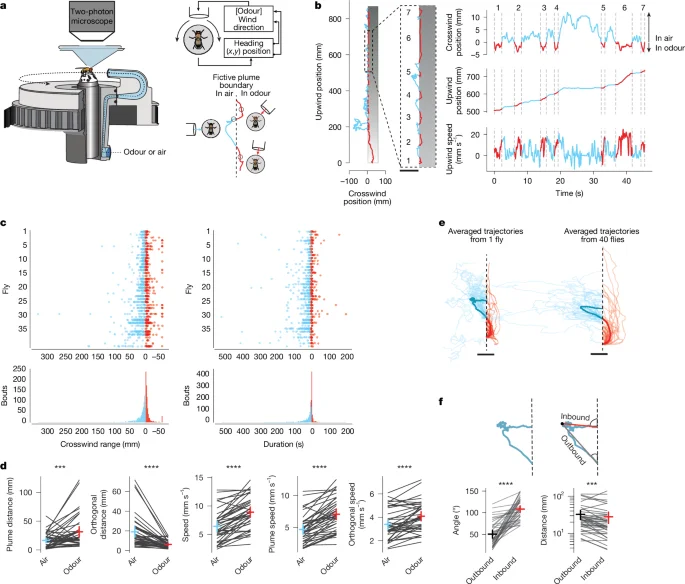
Memory-guided edge tracking enables vector-based olfactory navigation in fruit flies
Using a closed-loop olfactory VR, Drosophila track odor plumes by edge-tracking along the plume boundary and store a directional memory to return to that boundary, enabling a vector-based navigation strategy through dynamic plumes. Flies perform non-random, directed returns after leaving the plume, and neural data show FC2 neurons in the fan-shaped body encode the boundary-directed goal while EPGs coordinate heading, revealing a memory-enabled navigation toolkit within the central complex that adapts to changing plume geometries.