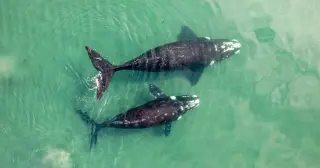
Researchers captured the first documented on-camera headbutts between sperm whales, observed in the Azores and Balearic Islands, showing that young whales initiate the behavior; the study, published in Marine Mammal Science, seeks to understand its function and invites others with footage to share.
Over six years at Fiji's Shark Marine Reserve, researchers observed 184 bull sharks across 473 dives and 8,192 minutes of underwater observation, finding they form social bonds, synchronize movements (parallel swims), and engage in lead-follow behaviors, with females dominating associations, younger sharks being more social, and older sharks less so—implying bull sharks have complex social lives beyond the predator stereotype.
A global experiment analyzed 110 sound pairs from 16 species (birds, frogs, insects, mammals) and found that about 4,000 human listeners tended to prefer the same calls animals use to attract mates. The stronger the animal preference, the more likely humans agreed, and participants were faster to pick the preferred sounds, suggesting shared neural processing in sound perception. The researchers note many questions remain, including why some humans still disagree and whether similar cross-species preferences exist for visuals or smells.
A six-year study of 184 bull sharks at Fiji’s Shark Reef Marine Reserve shows they have active, complex social lives. Researchers documented stable associations, lead-follow interactions, and parallel swimming, with adults forming the core of the network. Males tended to have more social connections than females, and social ties were strongest among similarly sized individuals. While socializing is common among adults, younger sharks are more represented in social activity likely to avoid predation, and older sharks appear less social overall. The researchers emphasize many questions remain about whether these sharks hunt or mate cooperatively, and more studies are needed to fully understand their social dynamics.
A new study shows the horse’s neigh is a two-tone sound: a low-pitched voice-box vibration paired with a high-pitched whistle that escapes through a tiny opening. Researchers filmed inside horses’ noses and analyzed dead horses’ laryngeal tissues to confirm the dual mechanism, making horses the first known large mammals to whistle while they vocalize. The two frequencies may help convey multiple emotions or messages during social interactions.
On Golem Grad island in Lake Prespa, Hermann’s tortoises are outnumbered by males 19 to 1, leading to relentless harassment that injures females and drives some off the cliffs; enclosure experiments show even with an escape route, aroused males cause island females to fall, while mainland females avoid exits. Most island females show genital injuries and many are not pregnant, unlike mainland populations where all females are pregnant. Scientists warn this extreme sex bias could trigger an extinction vortex, with projections suggesting the last female could die around 2083.
An Austrian cow named Veronika learned to use a broom as a tool to scratch hard-to-reach areas, with researchers documenting 76 tool‑use instances across seven trial sessions. The finding challenges assumptions about cattle intelligence and suggests cows may be capable of innovative problem‑solving and tool use under stimulating conditions.
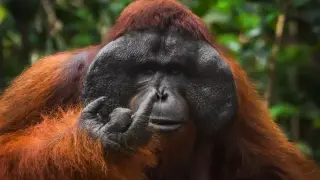
A Nature Ecology & Evolution study synthesizes data showing same-sex sexual behavior in 59 nonhuman primates (including bonobos, chimpanzees and macaques) with repeated instances in 23 species, suggesting such behavior helps reduce social tension, build bonds, and manage competition under environmental stress—driven by genetics and context rather than reproduction, though not all species are equally studied.
The article showcases the best nature photography of 2025, highlighting stunning images of animal behaviors and unique plant features, including a male gobbleguts fish incubating eggs in its mouth, a caterpillar with a 'mad hatter' headgear, an orb weaver spider illuminated by city lights, and a fluorescing pitcher plant, all recognized in prestigious photography competitions.
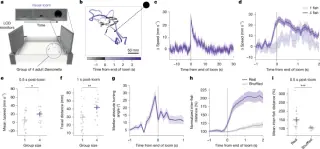
Research at Cornell University found that lab mice released into a natural, enclosed environment showed significantly reduced anxiety and more natural behaviors, suggesting that exposure to diverse experiences and environments can positively impact their mental health and potentially improve the reliability of scientific data. The study highlights the importance of environmental enrichment and may have implications for understanding human anxiety and well-being.
A raccoon in Virginia was found passed out in a liquor store after smashing bottles and getting drunk, highlighting raccoons' adaptability to urban environments and their tendency to scavenge alcohol, which is common in many ecosystems.
Research shows that shouting at seagulls is more effective than speaking softly or using bird songs to scare them away from food, suggesting that loud vocal deterrence can be a peaceful way to protect your picnic without harming the birds.
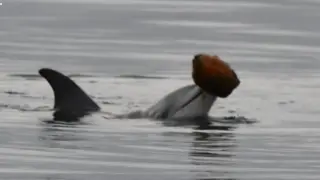
Australian humpback dolphins are observed wearing sea sponge hats as a courtship display to attract females, a behavior unique to certain regions in Western Australia, highlighting intriguing animal mating rituals.
Brainless animals like jellyfish, sea anemones, and hydras can learn, remember, and respond to stimuli through diffuse nerve nets, suggesting they possess a rudimentary form of cognition, though whether they can truly 'think' remains a complex and debated question among scientists.
Many animals, including sharks, birds, fish, and insects, are tricked by optical illusions that enhance their survival and reproductive success, revealing that perception is often about advantageous shortcuts rather than accuracy, and some animals even create illusions to influence others.