Tag

Sophos

All articles tagged with #sophos

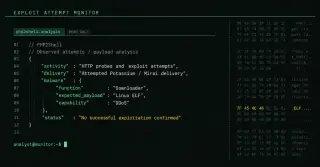
PHP2Shell Exploits Fail to Breach Millions as Attackers Struggle with Mirai Deployment
cybersecurity1 month ago

PHP2Shell Exploits Fail to Breach Millions as Attackers Struggle with Mirai Deployment

Attackers have launched massive, but largely unsuccessful, exploitation attempts against the critical PHP2Shell vulnerabilities (CVE-2026-109618 and CVE-2026-109619). While millions of scans have hit unpatched servers, no successful remote code execution (RCE) has been confirmed in the wild. Sophos identified a new Mirai variant called 'Potassium' in these attempts, which includes DDoS capabilities and encrypted command-and-control channels. Despite the high CVSS score of 9.2, experts note that reliable exploitation is proving difficult due to Address Space Layout Randomization (ASLR) protections. Patches are available for PHP 8.2 through 8.5, but millions of hosts remain vulnerable as organizations rush to update or take systems offline.


Sophos Identifies Bronze Sandcastle Group Exploiting Sandboxie for Backdoor Deployment
cybersecurity1 month ago

Sophos Identifies Bronze Sandcastle Group Exploiting Sandboxie for Backdoor Deployment

Sophos researchers have detailed the activities of Bronze Sandcastle, a China-aligned threat cluster active since mid-2025. The group targets organizations in Asia and Africa by abusing DLL sideloading, specifically leveraging legitimate Sandboxie executables to load malicious code. This technique allows attackers to bypass security tools and establish persistent backdoors that steal data and monitor system activity.

Sophos and ESET Detail Fileless Rootkit Exploiting F5 BIG-IP Flaw
cybersecurity2 months ago

Sophos and ESET Detail Fileless Rootkit Exploiting F5 BIG-IP Flaw

A sophisticated Linux rootkit is actively compromising F5 BIG-IP Access Policy Management (APM) devices by injecting fileless web shells into memory. The malware, identified as 'PoisonedRefresh' by ESET and analyzed by Sophos, leverages CVE-2025-53521 to bypass traditional disk-based detection. It modifies Apache and PHP runtime behavior to maintain persistent access without writing malicious files to the hard drive, posing a significant threat to unpatched enterprise gateways.

Sophos details STAC4749 campaign linking Teams vishing to Chaos ransomware
cybersecurity3 months ago

Sophos details STAC4749 campaign linking Teams vishing to Chaos ransomware

Sophos identified a financially motivated threat group, tracked as STAC4749, that used Microsoft Teams voice phishing to gain remote access to North American organizations between February and June 2026. The attackers impersonated IT support using fake .top domains and tools like Quick Assist and RemSupp. At least three intrusions resulted in Chaos ransomware deployment, with one case moving from initial access to encryption in under 17 hours. Sophos attributes the operation to criminal actors linked to former BlackSuit members, not state-sponsored groups.

"Ransomware Exploits Critical ConnectWise ScreenConnect Flaws"
cybersecurity2 years ago

"Ransomware Exploits Critical ConnectWise ScreenConnect Flaws"

Sophos X-Ops is tracking a wave of vulnerability exploitation targeting unpatched ConnectWise ScreenConnect installations, with attackers deploying malware to servers and workstations. ConnectWise has released a security advisory highlighting two critical vulnerabilities, urging immediate patching to version 23.9.8. Cloud-hosted implementations have received updates, but self-hosted instances remain at risk until manually upgraded. Sophos observed active exploitation in the wild, including attacks involving LockBit ransomware and other malware. Recommendations include confirming deployment type, scanning for unpatched instances, and implementing security measures. Sophos also provides detection and protection rules, as well as incident response guidance for organizations to mitigate risks and investigate potential incidents.

Beware of Fake ChatGPT Apps and AI Tools Distributing Malware
cybersecurity3 years ago

Beware of Fake ChatGPT Apps and AI Tools Distributing Malware

Fake ChatGPT apps are being created by developers to trick users into paying for expensive subscriptions, according to a report by cybersecurity firm Sophos. These apps, known as fleeceware, bombard users with ads until they sign up for a subscription, which can cost anywhere from $10 a month to $70 a year. Sophos has reported these apps to Apple and Google, and many have been removed from their respective app stores. To access ChatGPT without getting scammed, users can sign up for OpenAI's ChatGPT Plus for $20 a month or use Bing Chat, which has partnered with OpenAI to bring ChatGPT to its search engine.