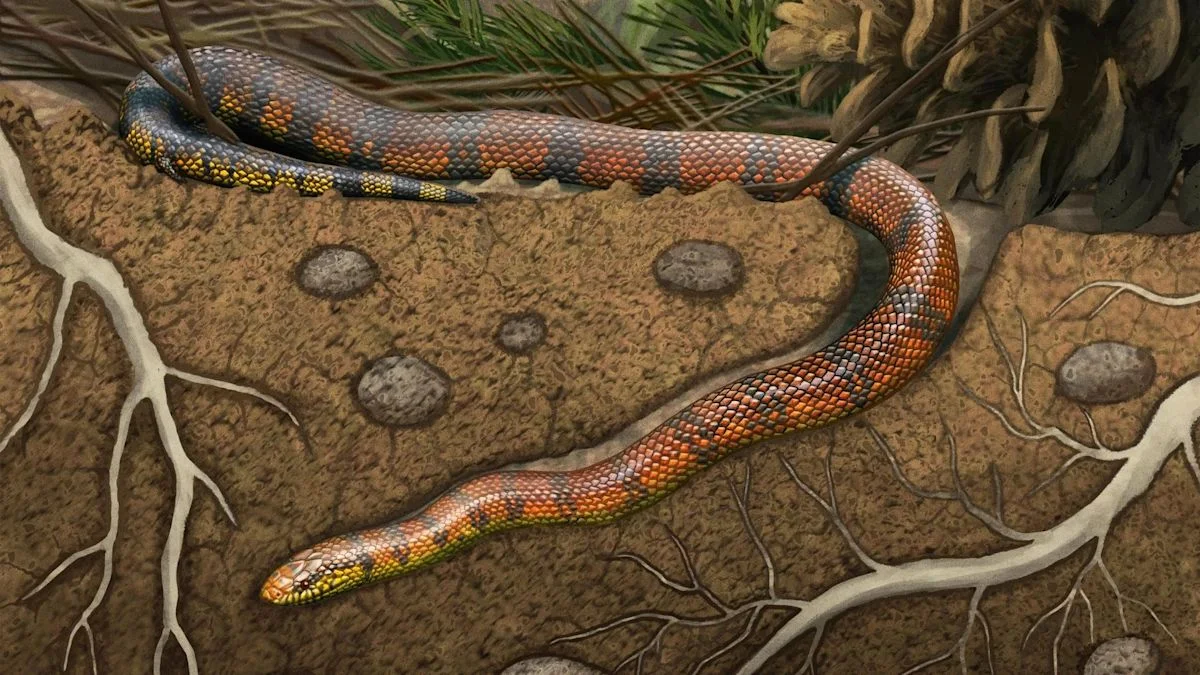
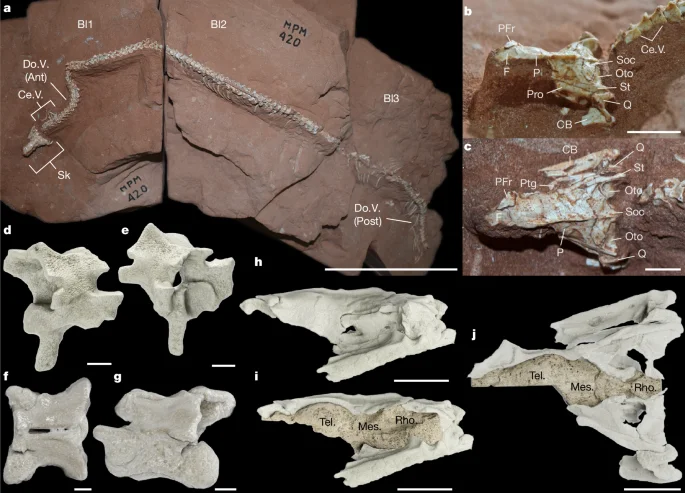
An 80-million-year-old snake fossil from Brazil, Tametara mirim, is unusually well-preserved and, with skull and brain evidence from micro-CT, indicates early snakes diversified into multiple habitats (including underground) soon after their origin, challenging a single linear narrative of snake evolution.
Researchers describe Tametara mirim, a well-preserved Late Cretaceous stem snake from Brazil, whose high‑resolution CT scans reveal a distinct brain and inner-ear morphology consistent with fossorial life. Its endocast shows mildly enlarged cerebral hemispheres and a prominent pituitary, while the inner ear exhibits features typical of burrowing snakes, contrasting with coeval Dinilysia, a non‑fossorial stem snake. Phylogenetic analyses place Tametara among the earliest snakes, closely related to Najash, supporting a Middle Jurassic origin for snakes and a Late Cretaceous crown-snake radiation. The study, integrating geometric morphometrics of brain endocasts and bone microstructure, shows substantial early neuroanatomical and ecological disparity, indicating that multiple habitat shifts (fossorial and non‑fossorial) occurred in stem and crown snakes, and that ancestral snakes were ecologically diverse rather than uniform.