
AI Debt Boom Pushes US Treasury Yields to 2002 Highs
Tech giants are issuing record debt to fund AI infrastructure, driving US Treasury yields to 5.30% and crowding out government borrowing.

All articles tagged with #us treasury bonds
Tech giants are issuing record debt to fund AI infrastructure, driving US Treasury yields to 5.30% and crowding out government borrowing.
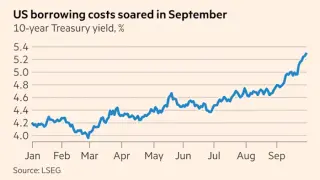
US government bonds experienced their worst monthly performance in four years in September, with 10-year Treasury yields rising by more than 50 basis points to reach 5.3%. This surge marks the highest level since 2007 and approaches rates last seen in 2002. The sell-off in the $32 trillion market has evolved into a self-reinforcing cycle where rising yields force institutional investors to divest long-term debt, further pushing borrowing costs higher. While initial concerns stemmed from inflation and public debt, technical factors now dominate, with no significant buyers stepping in to stabilize prices.

The 10-year US Treasury yield reached 5% on Monday, its highest level since 2023, driven by surging oil prices and inflation fears. This move follows a global bond sell-off and marks a setback for Treasury Secretary Scott Bessent’s efforts to lower borrowing costs.

Stephen Miran argues that recent increases in long-dated US Treasury yields are driven by higher expectations for economic growth rather than concerns over fiscal or monetary credibility. He notes that inflation expectations remain stable near the Federal Reserve’s 2% target, and term premiums have not risen, indicating that markets do not doubt the government’s ability to manage debt. Miran attributes the yield rise to real rates reflecting stronger growth prospects, potentially fueled by AI, deregulation, and tax policy. He supports Treasury Secretary Scott Bessent’s strategy of providing liquidity to reduce volatility, arguing that deficits are temporary due to tariff fluctuations and will decline as growth accelerates. Miran warns that forcing longer-term issuance could exacerbate unnecessary volatility in an already illiquid market, harming financial stability and taxpayers.

U.S. 30-year Treasury bond yields have surged to 5.3%, their highest level since 2007, driven by a record $40 trillion national debt and inflationary pressures from trade wars and the Iran conflict. Treasury Secretary Scott Bessent attempted to lower yields through temporary bond buybacks and regulatory rollbacks, but these measures failed to sustain market confidence. The administration’s actions, viewed by some as politically motivated ahead of midterms, have not addressed underlying fiscal concerns, leading to rising mortgage rates and economic uncertainty.

Friday’s joint US–Japan yen intervention briefly steadied dollar-yen around 156 after a move toward 164, but the FT’s Unhedged argues the motive is self‑preservation: shielding US Treasuries from higher yields by signaling Fed‑backed dollar liquidity via the FIMA facility, with Japan’s yields, US payrolls and Fed messaging likely to determine whether the effect lasts.

Following the Fed’s decision to hold rates, Warsh’s press conference spooked markets and sparked an unusual bear steepener in Treasuries: the two‑year yield fell as rate–hike odds declined, while the 30‑year yield surged to about 5.2%, the highest since 2007, signaling investor concerns about Warsh’s ability to rein in inflation and a growing credibility premium.
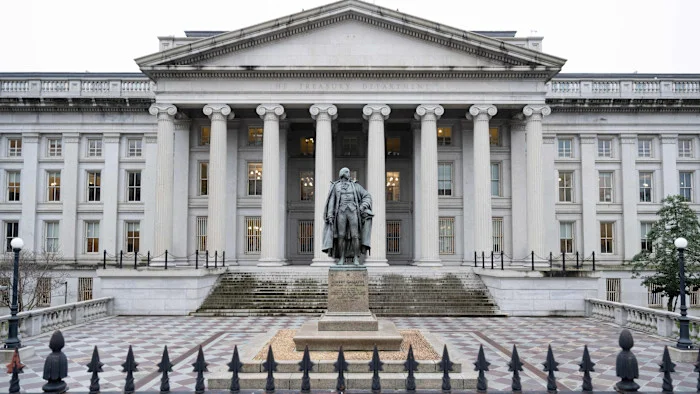
The $30 trillion US Treasury market is showing signs of strain as the Iran war drives broader market volatility and thinning liquidity, with market depth shrinking, electronic trading disrupted, and shorter-dated notes and inflation-linked Treasuries most affected, while auctions underperform and traders reassess the Fed’s rate path.
Investors are fleeing US debt as the Iran war raises inflation fears, sending two-year Treasury yields to about 3.9% and the 10-year to around 4.38%, the largest moves this year; a $69 billion two-year auction drew weak demand while futures price in fewer Fed rate cuts for longer, with mortgage rates climbing toward 6.3% and borrowing costs rising globally.

US Treasury bonds have surged to local highs, raising concerns among analysts about potential recession risks. The rise follows disappointing nonfarm payroll data and increased economic uncertainty, with gold prices also reaching new highs. Analysts, including Michael A. Gayed, have expressed alarm over the bond market's movements, suggesting that high inflation, Federal Reserve interest rates, and geopolitical tensions may be contributing factors. Additionally, significant insider trading by major company executives and foreign countries selling US debt further highlight market apprehensions.

U.S. Treasury bonds, often considered the safest asset, have actually performed poorly for nearly two generations and continue to underperform. Investments in 10-year Treasury notes have lost a third of their value in real terms in just over three years, and long-term Treasurys have lost about half their value. They have consistently failed to keep up with inflation since 2008 and have been a worse investment than gold bullion. The U.S. government's massive budget deficits and increasing national debt, coupled with the need for inflation to reduce the debt burden, suggest that inflation is the only way out of the current economic conundrum. As a result, investors in Treasury bonds may face significant losses, and corporate bonds also face challenges. In this scenario, assets such as energy stocks, agricultural and mining stocks, real estate, and gold may perform well, while long-term Treasury bonds are unlikely to be a safe or risk-free investment.
US Treasury bonds are on track to experience their longest stretch of losses since 1787, with the 10-year bond set to suffer its third consecutive annual loss. The decline in bond prices has been driven by aggressive interest rate hikes from the Federal Reserve, with the effective fed funds rate rising from nearly 0% to over 5% since March 2022. Despite the poor performance, investors continue to pour money into bonds, with $1.7 billion flowing in this week, marking the 23rd consecutive week of inflows.

U.S. Treasury yields surged after the release of revised Q1 GDP data, which showed a 2% increase, surpassing the consensus of 1.4%. The U.S. 30-Year Treasury yield rose by 9 basis points to 3.89%, the U.S. 10-Year Treasury yield increased by 12 basis points to 3.83%, and the U.S. 2-Year Treasury yield jumped by 15 basis points to 4.87%. The inverted yield curve also widened, reaching levels not seen since 1981. The rise in yields pushed down U.S. Treasury bonds, while boosting the dollar.