Tag

Viscosity

All articles tagged with #viscosity

Life's Flow: New Fine-Tuning Hypothesis Links Constants to Cellular Fluid Dynamics
science25 days ago

Life's Flow: New Fine-Tuning Hypothesis Links Constants to Cellular Fluid Dynamics

A Queen Mary University of London team proposes that the Universe’s fundamental constants lie in a narrow range that keeps liquids—like water and blood—flowing in a way compatible with life. Even small changes could drastically alter viscosity and diffusion, potentially preventing cellular processes and life as we know it. Building on earlier work linking viscosity to physical limits, the study adds a biology-focused angle to the fine-tuning discussion, suggesting a possible second layer of tuning that governs whether life can emerge. While theoretical and speculative, follow-up work is exploring how cellular liquid motion could constrain constants and reflect deeper connections between physics and biology.

When Liquids Snap: A New Solid-Like Fracture Under Stress
science1 month ago

When Liquids Snap: A New Solid-Like Fracture Under Stress

Scientists found that simple, viscous liquids can fracture like solids when pulled beyond a 'critical stress,' with the threshold depending on stress per area rather than viscosity. The rapid fractures travel at 500–1,500 m/s—consistent with cavitation—and were observed in tar-like hydrocarbons and styrene oligomer, hinting that many liquids might exhibit this behavior and opening potential for applications in inkjet printing, soft robotics, and 3D printing.

Pitch Drop Experiment Nears a Century of Patience
science4 months ago

Pitch Drop Experiment Nears a Century of Patience

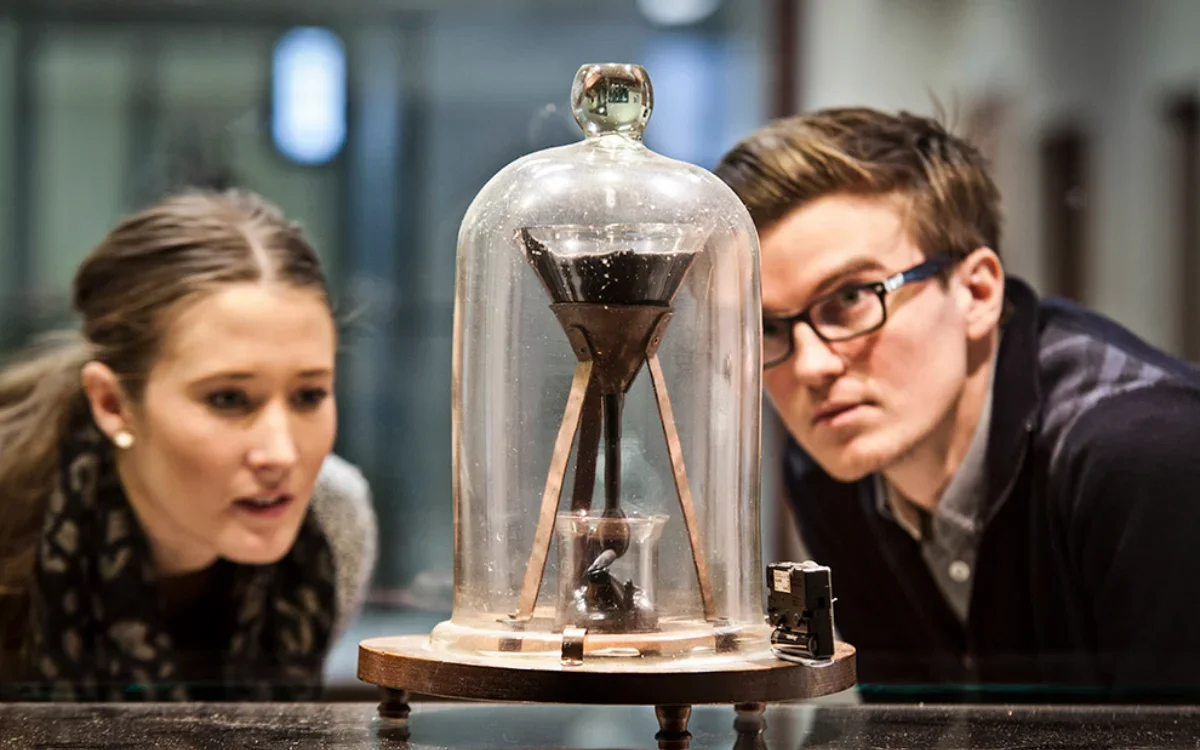
The Pitch Drop experiment at the University of Queensland, started in 1927 to illustrate pitch viscosity, is approaching its 100-year mark; drops have appeared after long waits (the first after eight years) and later intervals extended to 161 months, no one has ever seen a drop land, and the setup is expected to run for about another century with the next drop likely in the 2020s.

Physicist Unveils Overlooked Aspect of Einstein's Relativity
science1 year ago

Physicist Unveils Overlooked Aspect of Einstein's Relativity

Physicist Alessio Zaccone has discovered a new effect of Einstein's theory of special relativity on fluids, termed "fluid thickening," which describes how fluid viscosity changes under relativistic conditions. This groundbreaking theory, detailed in Physical Review E, combines relativistic equations with current fluid dynamics theories to explain viscosity behavior at near-light speeds and high temperatures. Zaccone's work suggests a potential new fundamental law of physics, enhancing our understanding of relativistic effects on fluids and their implications in astrophysics and high-energy physics.

Einstein's Relativity Theory Expanded to Real Fluids
science1 year ago

Einstein's Relativity Theory Expanded to Real Fluids

A new theory extends Einstein's relativity to real fluids, proposing a relativistic theory of viscosity that accounts for the effects of high-speed motion on fluid properties. This theory, based on the relativistic Langevin equation, suggests that fluid viscosity increases with speed, analogous to length contraction and time dilation, and introduces the concept of "fluid thickening" at relativistic speeds. The findings have implications for understanding high-energy fluids like quark-gluon plasma in astrophysics and high-energy physics.

Cracking the Code of Oobleck: Unraveling the Mystery of its Dual Nature
science-and-technology2 years ago

Cracking the Code of Oobleck: Unraveling the Mystery of its Dual Nature

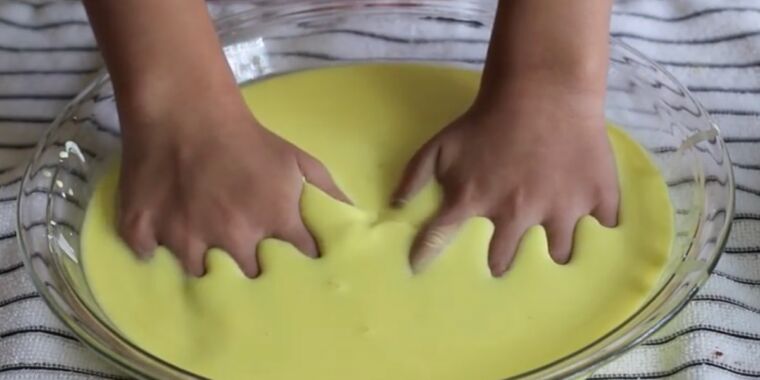
Scientists at the University of Chicago have used dense suspensions of piezoelectric nanoparticles to study the molecular behavior of oobleck, a non-Newtonian fluid that can behave as both a liquid and a solid. Oobleck's viscosity changes in response to applied strain or shearing force, making it a shear-thickening fluid. The researchers developed a mathematical model to predict the transition of oobleck from liquid to solid and back again, taking into account factors such as particle size and electrical charges. Computer simulations of previous experiments confirmed the accuracy of the model's predictions.