
Auto Giants Pivot to Heavy Extended-Range EVs to Fix Range Anxiety
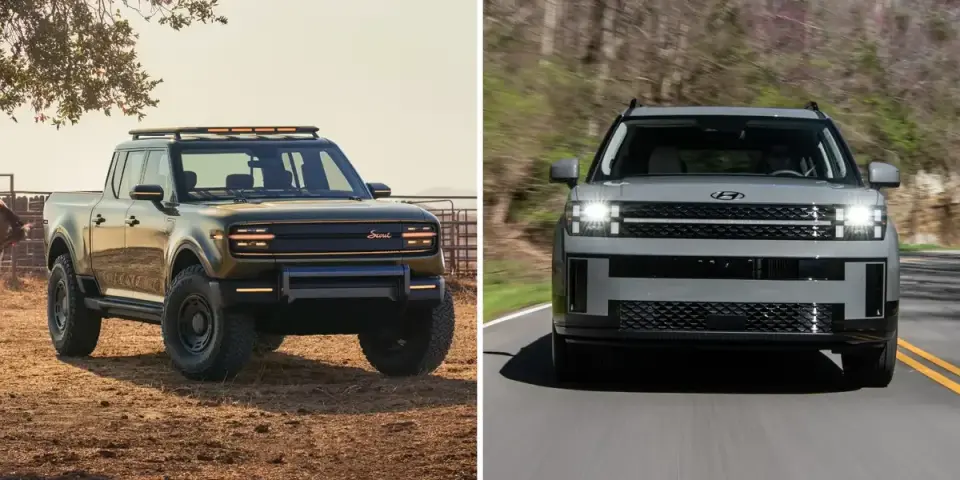
Major automakers are shifting focus to extended-range electric vehicles (EREVs) to address slow EV adoption. These vehicles combine large batteries with gas generators, offering 120-150 miles of electric range plus hundreds more via gasoline. Brands like Stellantis, Ford, and Hyundai plan launches by 2027-2028, aiming to solve range anxiety without relying solely on charging infrastructure.
Key points
- Stellantis’ Ram 1500 REV, launching in early 2027, offers 145 miles of electric range and 690 total miles, weighing 7,507 pounds.
- Hyundai plans a Santa Fe EREV in early 2027 with over 600 miles of range, while Ford’s F-150 Lightning will return as an EREV after its all-electric version’s poor sales.
- EREVs are mechanically simpler than plug-in hybrids (PHEVs) but heavier and more expensive than gas vehicles, with prices expected between $60,000 and $100,000 for the Ram.
- PHEVs accounted for only 1.4% of US vehicle sales in Q2 2026, down from 1.9% a year earlier, prompting the industry pivot.
- The US lacks subsidies for EREVs, unlike China, where they qualify as new energy vehicles, making the business case reliant on consumer willingness to pay a premium.
Background
This shift follows years of disappointing EV adoption and the failure of PHEVs to gain traction. Ford’s recent $19.5 billion restructuring and the cancellation of its all-electric F-150 Lightning highlight the industry’s struggle with high-cost EVs. Meanwhile, Ford is simultaneously betting on the affordable $29,945 Fathom EV pickup, illustrating conflicting strategies to address EV market challenges. The absence of US subsidies for EREVs, such as the expired $7,500 credit, contrasts with China’s supportive policies, where companies like Li Auto have successfully commercialized EREVs.
How outlets are covering it
Business Insider emphasizes EREVs as a practical solution for Americans who want electric driving without charging infrastructure dependence, citing expert opinions that they make sense for large trucks and SUVs. Business Model Analyst, however, critiques EREVs as a regression, noting they add weight and cost without simplifying the powertrain, unlike the EV thesis of subtraction. It highlights Ford’s contradictory approach, funding both an affordable EV and a premium EREV, and questions whether consumers will pay extra for redundancy. The two outlets agree on the industry’s pivot but differ on whether EREVs are a viable solution or a costly compromise.
Why it matters
The EREV trend signals a strategic retreat from pure EVs, reflecting consumer resistance to high prices and range anxiety. It impacts the automotive supply chain, reviving engine and generator manufacturers, and challenges the EV narrative of simplicity. Success depends on consumer acceptance of higher costs and the absence of subsidies, potentially reshaping the US auto market’s trajectory.
What to watch
Watch for the 2027 launch of the Ram 1500 REV and Hyundai’s Santa Fe EREV, and monitor sales data to gauge consumer acceptance. Ford’s dual strategy with the Fathom EV and EREV Lightning will test whether price or range is the primary barrier to EV adoption. The absence of US subsidies may limit EREV growth, while China’s continued success with EREVs could influence global trends.
- Automakers are betting on a different kind of electric car. Meet the EREV. Business Insider
- Carmakers Have a New Idea to Boost EV Range: Add a Gas Engine WSJ
- Gas-Assisted EVs Could Ease Range Anxiety Newser
- Why Ram's Range-Extended Truck Solves A Towing Problem Pure EVs Mathematically Cannot CarBuzz
- Detroit’s Fix for the EV Nobody Bought Weighs 3.75 Tons Business Model Analyst
Want the full story? Read the original reporting
Read on Business Insider