
Global Bond Yields Hit Decade Highs as Middle East Tensions Fuel Inflation Fears
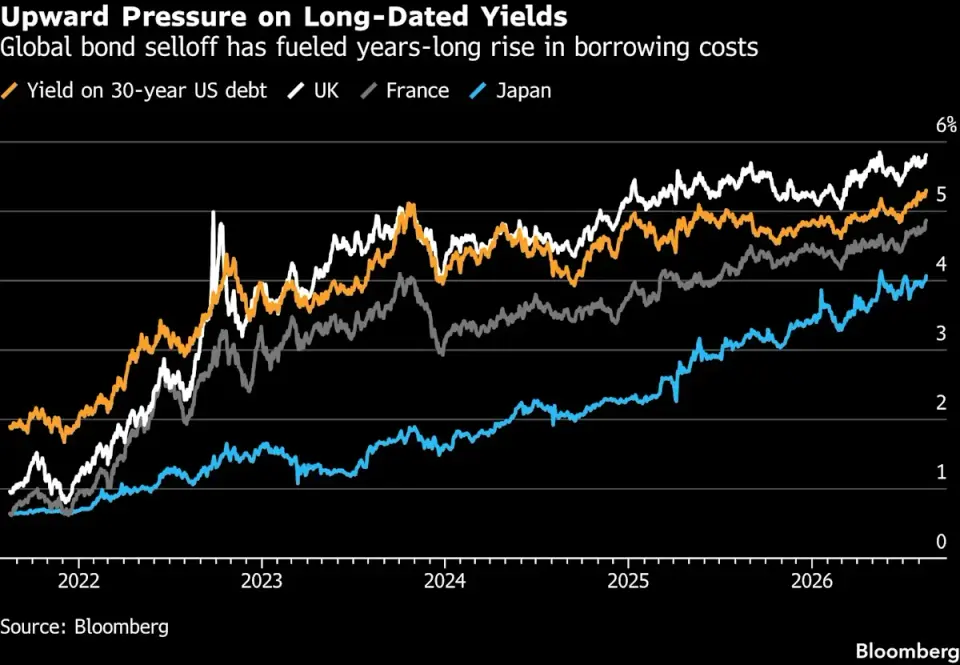
Long-term government borrowing costs across major economies have surged to levels not seen since the 2008 financial crisis or earlier. The 30-year US Treasury yield reached 5.29%, its highest since 2007, while France’s 30-year bond yield hit a peak since September 2008. Japan’s 10-year yield climbed to 2.93%, a three-decade high. Investors are demanding higher returns due to persistent inflation risks and fears that central banks will maintain tight monetary policy. The Middle East conflict has exacerbated these trends by pushing oil prices up 6% last week, raising concerns about sustained price pressures. Market data indicates an 85% probability that the European Central Bank will raise rates in September, reflecting widespread anxiety over fiscal sustainability and inflation control.
Key points
- US 30-year Treasury yield rose to 5.29%, the highest level since 2007, according to The Guardian.
- France’s 30-year bond yield reached 4.8558%, its highest since September 2008, with the 10-year yield hitting a peak since June 2009.
- Germany’s 10-year bond yield rose to 3.2138%, its highest since 2011, while Japan’s 10-year yield hit 2.93%, a three-decade high.
- Oil prices increased by 6% last week due to the Middle East crisis, with Brent crude rising further as US-Iran tensions persisted.
- Market indicators show an 85% chance the European Central Bank will raise interest rates in September, per The Guardian.
- Robin J Brooks notes that Japan’s yield curve is the most distorted, with 'shadow yields' significantly higher than observed rates, indicating a de facto debt crisis.
Background
This development follows a series of recent spikes in US Treasury yields. In August 2026, the 30-year yield reached 5.26%, driven by heavy government borrowing, including a $742 billion issuance week, and persistent inflation above the Federal Reserve’s target. Analysts have linked rising long-term yields to increased corporate debt issuance, particularly from AI-driven infrastructure investments, which has reduced demand for long-dated Treasuries. The current surge extends these trends globally, with multiple advanced economies now facing borrowing costs at or near historical peaks.
How outlets are covering it
The Guardian emphasizes the broad, synchronized nature of the yield spike across G7 nations, linking it directly to Middle East-driven oil price increases and inflation fears. It highlights specific historical benchmarks, such as the US 30-year yield matching 2007 levels and France’s 30-year yield matching 2008 levels. Robin J Brooks, in contrast, focuses on the structural distortion of yield curves, particularly in Japan. He argues that while US and European yields are high, Japan’s situation is uniquely severe due to central bank manipulation of bond markets, creating a 'currency crisis' rather than a traditional debt crisis. Brooks notes that 10-year forward yields rose across all G10 nations despite dovish US inflation data, suggesting deep-seated fiscal concerns that override short-term economic cooling. The two sources agree on the severity of the situation but differ in emphasis: The Guardian focuses on the immediate geopolitical and inflationary triggers, while Brooks highlights the underlying structural fragility and market manipulation, particularly in Japan.
Why it matters
Rising long-term borrowing costs increase the expense of mortgages, business loans, and government debt servicing, potentially slowing economic growth. For central banks, this creates a dilemma: raising rates to combat inflation may stifle growth, while keeping rates low risks allowing inflation to spiral. The Middle East conflict adds uncertainty by driving up energy costs, which could sustain inflationary pressures. For investors, the shift to higher yields signals a more expensive borrowing environment and may lead to reduced risk appetite in equity markets. The divergence in yield curve shapes, particularly in Japan, suggests that some economies may face more severe fiscal stress than others, potentially leading to currency instability or default risks if debt levels remain unmanageable.
What to watch
Market participants will closely watch the European Central Bank’s September meeting for signals on rate hikes, given the 85% probability of an increase. The Bank of Japan may need to act to support the yen and contain inflation, potentially raising rates as soon as September. Oil prices will remain a key variable, with further spikes possible if Middle East tensions escalate. Investors may continue to demand higher yields for long-dated government debt, particularly in countries with high debt-to-GDP ratios. The Federal Reserve’s response to persistent inflation and rising yields will also be critical, as it may need to balance between curbing inflation and avoiding a recession. The coming weeks will test whether central banks can manage the trade-off between inflation control and economic growth in a high-rate environment.
- Global Bond Rout Sends Long-Term Borrowing Costs to Highest in Decades Yahoo Finance
- Trading Day: Bonds play the blues Reuters
- Leading economies’ borrowing costs hit highest since 2008 crisis The Guardian
- Bonds Face a Bigger Threat Than the Fed as Global Rates Climb Bloomberg.com
- Where is the Global Debt Crisis Most Acute? Robin J Brooks | Substack
Want the full story? Read the original reporting
Read on Yahoo Finance