
Treasury's $6B Bond Buyback Backfires as Yields Hit Three-Year High
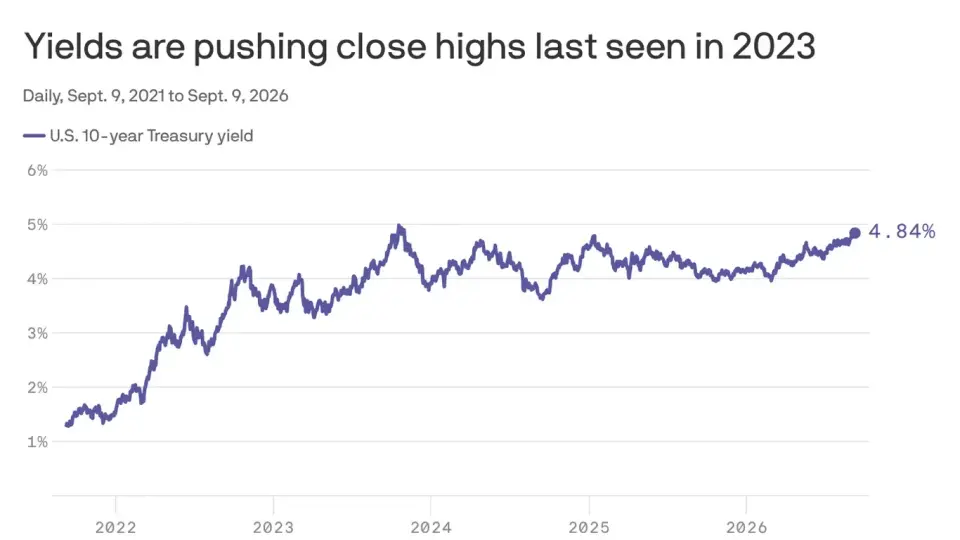
The U.S. Treasury’s expanded bond buyback program failed to lower interest rates, with the 10-year yield spiking to 4.85%, its highest level since October 2023. Despite tripling the planned purchase size to $6 billion, investors viewed the move as insufficient against the scale of U.S. debt, leading to a sell-off in government bonds.
Key points
- The Treasury announced a $6 billion buyback of long-term bonds, triple the initially planned amount, but yields rose instead of falling.
- The 10-year Treasury yield briefly hit 4.85%, a three-year high, before settling at 4.84% on Wednesday.
- Analysts criticized the move as a 'Band-Aid' that fails to address structural deficit issues, noting the Treasury lacks unlimited funding.
- Treasury Secretary Scott Bessent warned currency traders, 'I am the house now,' but markets remained skeptical of the administration's ability to control rates.
Background
This follows a series of failed attempts by Treasury Secretary Scott Bessent to curb rising borrowing costs since August 2026. Previous buyback efforts had already failed to steady markets, with 30-year yields remaining above 5.28%. Critics, including investor Stanley Druckenmiller, have argued that without fiscal discipline, such interventions are merely a 'subsidy to procrastination' that risks undermining the credibility of U.S. Treasuries as a safe asset.
How outlets are covering it
Axios emphasizes that the buyback was too small to 'shock and awe' a $32 trillion market, with strategist Ira Jersey suggesting $10 billion or more would be needed. The New York Times frames the event as a 'swift rebuke' from the bond market, highlighting that yields rose to their highest level in three years despite the administration's efforts. CNBC notes that while Bessent warned traders he is 'the house now,' analysts at BMO Capital Markets worry the heavy-handed approach could damage the credibility of Treasuries as an asset class, with the 30-year yield remaining below the 5.3% threshold Bessent previously defended.
Why it matters
The failure of the buyback to lower yields suggests that market interventions may be adding to upward pressure on interest rates rather than easing them. This could increase borrowing costs for mortgages and consumer loans, potentially squeezing the economy and complicating the Federal Reserve's monetary policy stance amid rising inflation and deficit concerns.
What to watch
The Treasury is expected to conduct the first $6 billion buyback operation on Thursday, with markets watching both the offered amount and demand from debt holders. Future operations may see larger sizes, but analysts remain skeptical unless the administration addresses the underlying budget deficit or secures unlimited funding authority.
- Bessent fails to shock and awe the bond market Axios
- Bond Market Rebuffs Treasury’s $6 Billion Plan to Reduce Borrowing Costs The New York Times
- Bessent bond plan details to be revealed as Treasury secretary warns FX traders he's 'the house now' CNBC
- Bessent’s Upsized Buybacks Get Hit by Bond Market Reality Bloomberg.com
- Scott Bessent continues crusade against rising US government bond yields ft.com
Want the full story? Read the original reporting
Read on Axios