
Global Bond Yields Hit Decade Highs as Japan’s Curve Signals Deepening Fiscal Stress
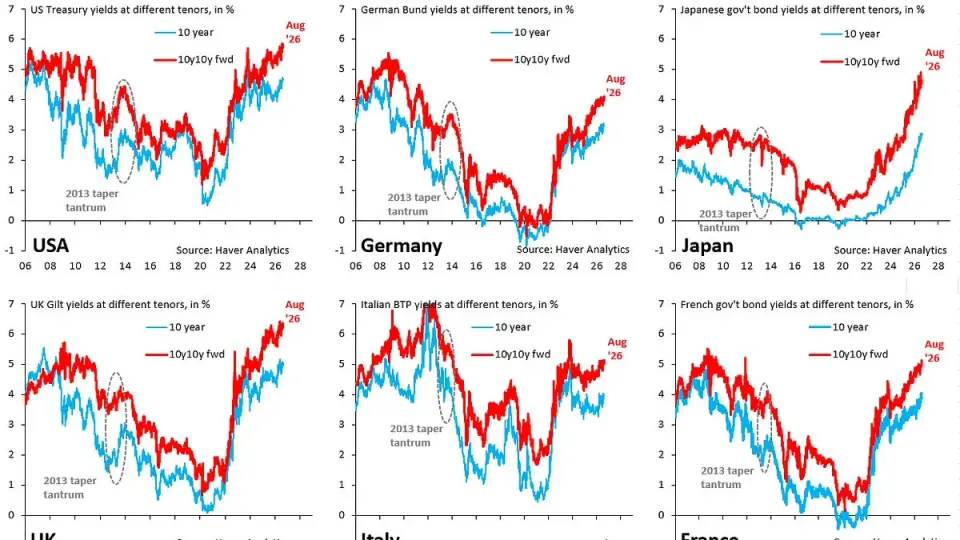
Long-term government bond yields across major economies have surged to multi-decade highs, with Japan exhibiting the most severe yield curve distortion. While dovish US inflation data initially suggested rate cuts, long-term yields rose globally, indicating markets are pricing in significant debt sustainability risks. Japan’s yield curve remains artificially capped by central bank intervention, creating a currency crisis that masks underlying fiscal distress. Other G10 nations, including France, the UK, and Germany, also see record-breaking yields, driven by inflation fears, fiscal concerns, and geopolitical tensions.
Key points
- Japan’s 10-year government bond yield reached 2.93%, its highest level since 1996, while its long-end yield curve shows a z-score near two, indicating statistically significant distortion compared to historical norms.
- The US 30-year Treasury yield hit 5.29%, its highest since 2007, and the 30-year TIPS yield reached 3.09%, its highest since 2008, reflecting broad-based stress in long-dated debt.
- France’s 10-year bond yield rose to 4.05%, its highest since 2009, and Germany’s 10-year yield hit 3.21%, its highest since 2011, as investors priced in persistent inflation and fiscal risks.
- Despite dovish US inflation data, long-term yields rose globally, with 10y10y forward yields increasing across the US, UK, Japan, Italy, and France, suggesting markets are discounting future rate cuts and pricing in higher risk premiums.
- The Bank of Japan faces pressure to raise rates to support the yen, but this risks further straining the economy, while the European Central Bank is expected to hike rates in September with an 85% probability.
Background
This development follows a period of rising global debt levels and central bank interventions that have distorted bond markets. Earlier reports highlighted concerns about household and corporate debt in various economies, but the current surge in long-term government bond yields marks a broader, systemic stress in sovereign debt markets. The situation is compounded by geopolitical tensions, particularly in the Middle East, which have pushed oil prices above $90 per barrel, adding to inflationary pressures.
How outlets are covering it
Robin J Brooks (Substack) emphasizes that Japan’s yield curve is the most dysfunctional, with artificially low yields masking a de facto debt crisis that has morphed into a currency crisis. He notes that Japan’s z-score for yield curve steepening is near two, indicating a statistically significant deviation from historical norms. The Guardian highlights the record-breaking yields across multiple economies, linking the surge to inflation fears, fiscal concerns, and geopolitical tensions, particularly the Middle East crisis. Investing.com (Reuters) focuses on the broad-based nature of the yield surge, noting that long-dated yields rose across the US, Europe, and Japan, driven by oil prices, fiscal fears, and sluggish demand at government debt auctions. While Brooks focuses on the distortion in Japan’s yield curve, the Guardian and Reuters emphasize the broader global stress and the role of inflation and geopolitical factors in driving yields higher.
Why it matters
The surge in long-term government bond yields signals growing concerns about debt sustainability across major economies. For Japan, the artificially capped yields have led to a currency crisis, with the yen under constant depreciation pressure. For other G10 nations, rising yields increase borrowing costs, potentially straining fiscal budgets and slowing economic growth. The situation could lead to further market volatility, as investors reassess the risk of debt crises and central bank policies. The broad-based nature of the yield surge suggests that the stress is not isolated to one country but is a global phenomenon, with implications for financial stability and economic growth worldwide.
What to watch
Markets will closely watch central bank actions, particularly the Bank of Japan and the European Central Bank, as they navigate the trade-off between supporting the economy and containing inflation. The Bank of Japan may need to raise rates to support the yen, but this could further strain the economy. The European Central Bank is expected to hike rates in September, with an 85% probability, as it seeks to combat persistent inflation. Investors will also monitor fiscal developments in the US and Europe, as rising debt levels and interest payments could further pressure bond markets. Geopolitical tensions, particularly in the Middle East, will continue to influence oil prices and inflation expectations, adding to the uncertainty in bond markets.
- Where is the Global Debt Crisis Most Acute? Robin J Brooks | Substack
- Leading economies’ borrowing costs hit highest since 2008 crisis theguardian.com
- Bonds Face a Bigger Threat Than the Fed as Global Rates Climb Bloomberg.com
- Trading Day: Bonds play the blues By Reuters Investing.com
- Bonds Got Scorched This Summer. 3 Things That Could Make Fall More Miserable. Barron's
Want the full story? Read the original reporting
Read on Robin J Brooks | Substack