
August 12 Eclipse Offers Limited Partial View for U.S., While Global Totality Hits Northern Hemisphere
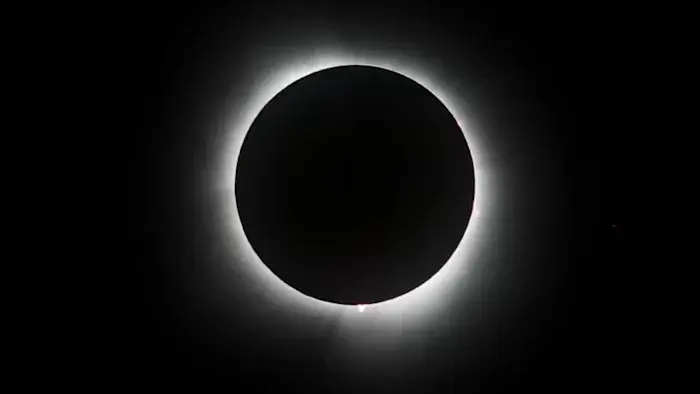
A total solar eclipse occurred on August 12, 2026, visible only in parts of northern Russia, Greenland, Iceland, Spain, and Portugal. The United States experienced a partial eclipse, with Detroit seeing approximately 3% solar coverage between 1:03 and 2:08 p.m. ET. NASA streamed the event live, while experts emphasized the need for certified eye protection during partial phases. This event followed the 2024 U.S. total eclipse and precedes the next total eclipse visible in the U.S. in 2033.
Key points
- Totality was limited to specific regions in the Northern Hemisphere, including northern Russia, Greenland, Iceland, Spain, and a small part of Portugal.
- Detroit’s partial eclipse began at 1:03 p.m. ET, peaked at 1:36 p.m. ET with 3% coverage, and ended at 2:08 p.m. ET.
- NASA began live streaming the event at 1:15 p.m. ET for those outside the path of totality.
- Viewers were advised to use specialized eye protection or solar filters, as naked-eye viewing is unsafe except during the brief moment of totality.
- The next total solar eclipse visible in the U.S. is scheduled for 2033, with subsequent events in 2044 and 2045.
Background
This event marks the first total solar eclipse visible from Earth in over two years. The previous total eclipse visible in the U.S. occurred on April 8, 2024, with only a small portion of southern Michigan experiencing totality. Recent archive coverage noted that millions across 27 U.S. states and Washington, D.C., could view the partial phase, with peak coverage in the East Coast and Alaska. Unlike the 2024 event, this eclipse did not cause significant sky darkening in the U.S. but offered a noticeable dimming in some areas.
How outlets are covering it
WDIV focused on local timing and safety for Michigan viewers, emphasizing the partial nature of the event in Detroit. The Chicago Tribune and WKRC sources, while primarily discussing blood donation crises, did not provide direct commentary on the eclipse, indicating a lack of cross-source debate on the astronomical event itself. No conflicting perspectives on the eclipse’s visibility or safety were found among the provided sources.
Why it matters
The eclipse highlights the rarity of total solar events and the importance of safe viewing practices. It also serves as a precursor to the next total eclipse visible in the U.S. in 2033, encouraging public interest in astronomical events and safety protocols. The event underscores the global nature of celestial phenomena, with totality limited to specific international regions while the U.S. experienced only a partial view.
What to watch
The next total solar eclipse will occur on August 2, 2027, visible in southern Spain, North Africa, Saudi Arabia, and Yemen. In the U.S., the next three total solar eclipses are scheduled for 2033, 2044, and 2045. Public interest is expected to grow as these dates approach, with continued emphasis on safe viewing methods and educational outreach.
- What to know ahead of Wednesday’s total solar eclipse ClickOnDetroit | WDIV Local 4
- Nessel warns Michiganders to protect themselves from scammers impersonating banks, credit unions ClickOnDetroit | WDIV Local 4
- Blood crisis raises concerns for families relying on transfusions Yahoo
- Hoxworth Blood Center urges donors to help meet critical summer blood shortage WKRC
- Letters: Our blood supply is critically low. We need Chicagoans to roll up their sleeves. Chicago Tribune
Want the full story? Read the original reporting
Read on ClickOnDetroit | WDIV Local 4