
Starship's First Orbital Flight Delivers 26 Satellites, Marking Start of Starlink V3 Era
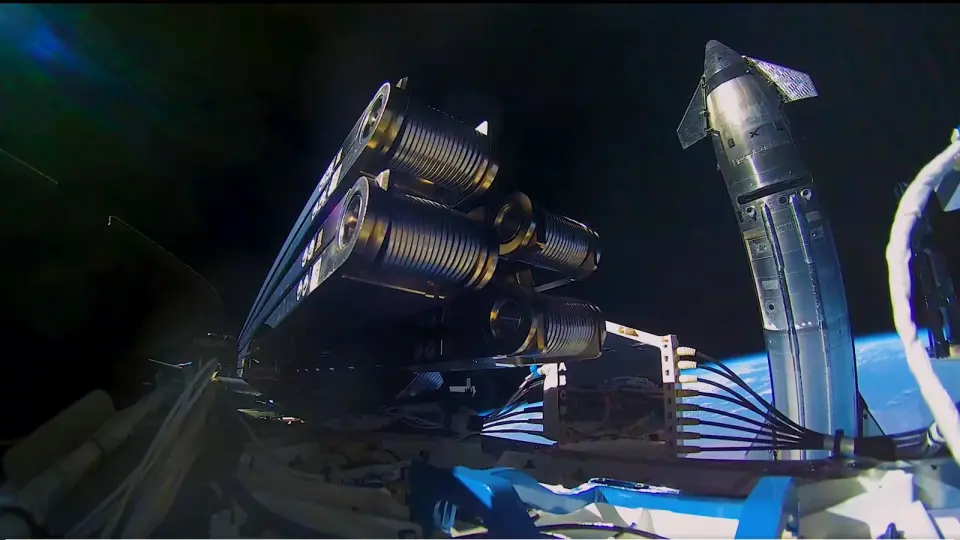
SpaceX's Starship rocket achieved its first orbital flight on September 28, 2026, successfully deploying 26 Starlink V3 satellites into low Earth orbit. This milestone marks the beginning of the next-generation satellite constellation, which is significantly heavier and more capable than its predecessors. Although the mission ended early due to an engine anomaly, the successful orbital insertion and payload deployment were confirmed by multiple sources.
Key points
- Starship reached orbit for the first time during its 14th test flight on September 28, 2026.
- The upper stage deployed 26 Starlink V3 satellites, initiating the construction of the new megaconstellation.
- Starlink V3 satellites weigh approximately 4,400 pounds (2,000 kg), roughly twice the mass of previous models.
- The new satellites support 1 Tbps downlink and 160 Gbps uplink capacity, requiring Starship's power for launch.
- The mission ended early due to an engine anomaly, but NASA praised the successful orbital insertion and deployment.
Background
This event follows earlier archive reports confirming that Starship Flight 14 was the first attempt to reach orbit, transitioning the vehicle from suborbital testing to orbital operations. Previous coverage noted that while the mission was cut short by technical issues, the successful deployment of 26 satellites was a historic milestone, occurring 18 years after Falcon 1's first orbital flight.
How outlets are covering it
Space.com emphasizes the historic nature of the first orbital flight and the successful deployment of Starlink V3 satellites, highlighting the technical specifications of the new satellites. Yahoo Finance, in contrast, focuses on the market reaction, noting that SpaceX's stock fell despite the successful launch, suggesting investor concerns may outweigh the technical achievement. The two outlets highlight different aspects of the same event: Space.com focuses on the technological milestone, while Yahoo Finance focuses on the financial implications.
Why it matters
The successful deployment of Starlink V3 satellites marks a significant step in SpaceX's plans to expand its satellite network. The new satellites are designed to provide significantly higher bandwidth and capacity, which could impact global internet services and space-based communications. The achievement also validates Starship's capabilities for future missions, including lunar and Mars exploration, despite ongoing technical challenges.
What to watch
SpaceX is expected to continue testing Starship and deploying more Starlink V3 satellites in the coming months. The company aims to launch 100,000 Starlink satellites to orbit, with the new V3 satellites playing a key role in this expansion. Future missions will likely focus on resolving the engine anomalies that caused the early splashdown of Flight 14.
- Wow! Watch SpaceX's Starship megarocket deploy satellites into orbit for 1st time ever (photos, video) Space
- SpaceX launches Starship into orbit for first time ever but cuts mission short Fox Business
- SpaceX Flew the Most Powerful Rocket Ever Built and the Stock Fell Anyway Yahoo Finance
- SpaceX's Starship engine failure could impact NASA's moon mission objectives Reuters
- SpaceX's Starship reaches orbit for the first time NPR
Want the full story? Read the original reporting
Read on Space