
Miro1 Accumulation Identified as Key Driver of Muscle Insulin Resistance in Type 2 Diabetes
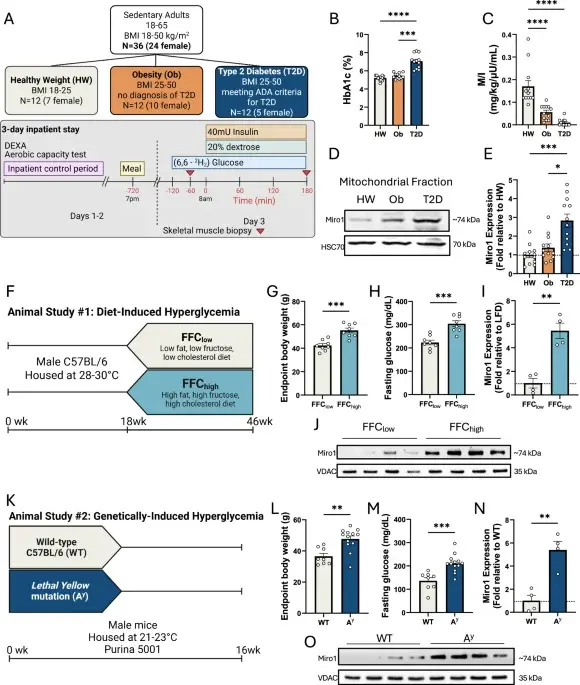
A new study identifies Miro1, a mitochondrial membrane protein, as a central regulator of insulin resistance in type 2 diabetes. Researchers found that Miro1 accumulates in the skeletal muscle of diabetic patients and mice, impairing glucose uptake and oxidative capacity. This buildup results from defective insulin signaling at the mitochondrial level, specifically a failure of AKT to interact with Miro1. Crucially, a randomized controlled trial demonstrated that 12 weeks of exercise training reduces Miro1 accumulation, improves mitochondrial structure, and restores insulin sensitivity. Genetic deletion of Miro1 in mice confirmed that its removal enhances glucose disposal and mitochondrial function, suggesting it as a potential therapeutic target.
Key points
- Miro1 protein accumulates specifically in the skeletal muscle of patients with type 2 diabetes, but not in those with obesity alone.
- The accumulation is caused by a failure of insulin-stimulated AKT to translocate to mitochondria and interact with Miro1, leading to its retention.
- A 12-week exercise trial showed that physical activity reduces Miro1 levels, improves mitochondrial elongation, and increases insulin sensitivity.
- Mice with muscle-specific Miro1 deletion exhibited lower fasting glucose, improved insulin signaling, and higher oxidative phosphorylation capacity.
- The findings suggest Miro1 acts as a negative regulator of insulin action, linking mitochondrial quality control to systemic glucose homeostasis.
Background
This research builds on recent findings regarding mitochondrial health in metabolic and aging contexts. Earlier studies highlighted how cardiolipin decline drives muscle fiber shifts in aging (2026-09-30) and how specific compounds like pterostilbene can stabilize proteins to burn muscle fat (2026-09-06). Additionally, the urgency of understanding insulin mechanisms is underscored by trials showing Type 1 diabetics can stop insulin via new drugs (2026-10-05) and concerns about rapid progression in youth-onset Type 2 diabetes (2026-10-13).
How outlets are covering it
The primary source, Nature, provides the detailed mechanistic data, including specific biochemical assays and genetic knockout results, emphasizing the causal link between Miro1 and insulin resistance. The secondary source, Bioengineer.org, frames the discovery as a potential therapeutic avenue, highlighting the contrast between Miro1's role in muscle versus pancreatic beta cells. Both sources agree on the core findings but differ in emphasis: Nature focuses on the molecular pathway and experimental validation, while Bioengineer.org contextualizes the findings within the broader economic burden of diabetes and potential future drug targets. No significant disagreements were noted between the outlets.
Why it matters
Identifying Miro1 as a mediator of insulin resistance offers a new target for treating type 2 diabetes, which affects over 500 million people globally. Understanding that exercise can reverse Miro1 accumulation provides a biological basis for the benefits of physical activity. Furthermore, this insight could lead to pharmacological interventions that mimic exercise effects, potentially addressing the root cause of insulin resistance rather than just managing symptoms.
What to watch
Researchers plan to conduct prospective human studies to track Miro1 levels as individuals transition from obesity to overt diabetes. Future work will also investigate the safety of directly modulating Miro1, considering its potential impact on muscle contractility. Clinical trials may eventually test drugs that inhibit Miro1 accumulation to restore insulin sensitivity.
- Miro1 mediates skeletal muscle insulin resistance in type 2 diabetes Nature
- Muscle protein Miro1 may drive insulin resistance, revealing potential type 2 diabetes treatment target Medical Xpress
- OKC Scientists Find Protein Linked To Type 2 Diabetes NewsRadio 1000 KTOK
- Oklahoma Diabetes Center Identifies New Protein Target for Type 2 Diabetes Treatment DongA Science
- Mitochondrial Protein Miro1 Emerges as a Driver of Muscle Insulin Resistance in Type 2 Diabetes Bioengineer.org
Want the full story? Read the original reporting
Read on Nature