
Cardiolipin Decline Drives Muscle Fiber Shifts in Aging
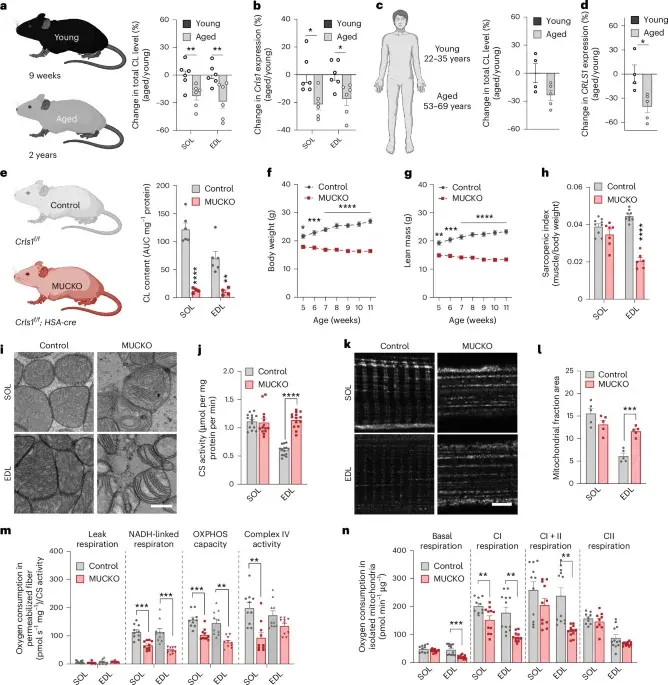
A new study in Nature Aging reveals that the decline of the mitochondrial lipid cardiolipin is a primary driver of muscle fiber type changes during aging. By depleting this lipid in young mice, researchers reproduced age-related muscle shifts and found that restoring it reversed atrophy and improved survival. While this highlights internal cellular mechanisms, other recent research points to nerve-muscle communication failures as a separate, reversible cause of age-related weakness.
Key points
- Cardiolipin levels drop in both mouse and human skeletal muscle as age increases, correlating with a shift from glycolytic to oxidative fiber types.
- Deleting the gene Crls1, which synthesizes cardiolipin, in young mice mimics aging hallmarks, including muscle atrophy and metabolic shifts.
- The shift is mediated by the estrogen-related receptor gamma, which triggers antioxidant defenses in response to mitochondrial stress.
- Restoring Crls1 expression in adult knockout mice reversed muscle atrophy and fully rescued premature mortality, suggesting potential therapeutic avenues.
- This finding complements recent research on neuromuscular junction failures, offering a dual perspective on the cellular and neural drivers of age-related muscle weakness.
Background
This study builds on earlier findings regarding mitochondrial lipid dynamics in aging, such as the 2026 research on phosphatidylcholine decline. It also aligns with recent discoveries on gut microbiome influences on muscle strength and the 2026 identification of neuromuscular junction failures as a key driver of sarcopenia, providing a broader context for age-related muscle decline.
How outlets are covering it
Nature Aging emphasizes the internal cellular mechanism of cardiolipin loss as a causal factor in fiber-type adaptation, highlighting its reversibility. In contrast, ScienceDaily and Yahoo focus on external neural factors, specifically the failure of the neuromuscular junction and the role of the protein NaV1.4, suggesting that treating sarcopenia may require targeting nerve-muscle communication rather than just muscle cell metabolism. While both perspectives identify reversible causes for age-related weakness, they point to distinct biological pathways: mitochondrial lipid integrity versus neural signal transmission.
Why it matters
Understanding the specific molecular triggers of muscle aging, such as cardiolipin depletion, offers new targets for interventions that could reverse muscle atrophy and improve healthspan. This complements existing research on neural factors, suggesting a multi-faceted approach to treating sarcopenia in older adults.
What to watch
Researchers will likely explore therapeutic strategies to restore cardiolipin levels or modulate the estrogen-related receptor gamma pathway in humans. Parallel efforts will continue to test ClC-1 inhibition for neuromuscular junction failures, potentially leading to combined treatments for age-related muscle weakness.
- Mitochondrial membrane lipid cardiolipin controls fiber-type adaptations in aging muscle via estrogen-related receptor γ Nature
- The hidden switch behind one of the biggest paradoxes in aging muscle Medical Xpress
- Discovery could help older adults maintain muscle strength futurity.org
- Aging muscles may be losing strength for a reason scientists missed ScienceDaily
- Aging Muscle Has a Hidden Molecular Switch Yahoo
Want the full story? Read the original reporting
Read on Nature