Tag

Mitochondria

All articles tagged with #mitochondria

Ancient cell mergers: the idea that powers all life—and was almost dismissed
science10 hours ago

Ancient cell mergers: the idea that powers all life—and was almost dismissed

Fifteen journals rejected Lynn Margulis’s 1966 proposal that all complex life arose from ancient mergers of cells; her eventual 1967 paper On the Origin of Mitosing Cells argued mitochondria and chloroplasts are descended from free-living bacteria absorbed by early cells. The theory gained support as evidence accumulated—mitochondrial DNA resembles bacterial genomes, they reproduce by binary fission, and their ribosomes are bacterial-like—leading to the acceptance of endosymbiosis and, later, recognition of secondary endosymbiosis and extensive horizontal gene transfer. The result is a view of life as a web of cooperative mergers, not a simple tree.

Nerve Pain Could Be Eased by Recharging Neurons with Fresh Mitochondria
health-and-medicine1 day ago

Nerve Pain Could Be Eased by Recharging Neurons with Fresh Mitochondria

Duke University researchers showed that damaged nerves can be revived by transferring healthy mitochondria from glial cells to sensory neurons, significantly reducing pain in models of diabetic and chemotherapy-induced neuropathy and suggesting a new way to treat chronic pain at its source. More studies are required to understand the mechanism and validate this approach in humans.

Formoterol Reverses Fatty Liver Damage, Sparking Clinical Trials
health2 days ago

Formoterol Reverses Fatty Liver Damage, Sparking Clinical Trials

A decades-old asthma drug, formoterol, reversed fatty liver damage in mice modeling MASH and showed associations with fewer severe liver complications in people taking beta-2 agonists; MUSC researchers are moving to human trials to test whether the drug can treat MASH and diabetic kidney disease by boosting beta-2 signaling and mitochondrial biogenesis, though causal proof in humans is not yet established.

Metformin’s Hidden Target: The Gut Takes Center Stage
science5 days ago

Metformin’s Hidden Target: The Gut Takes Center Stage

New Northwestern University research in mice shows metformin mainly acts in the intestine, lowering blood sugar by reducing mitochondrial activity in gut cells and prompting them to burn more glucose, challenging the idea that the liver is the primary target. Published in Nature Metabolism, the study links berberine to a similar gut pathway and uses engineered mice to show that blocking mitochondrial complex I in the gut is central to metformin’s effect, with implications for gut-targeted diabetes therapies.

Spaceflight Leaves Lasting Molecular Footprints, Twin Study Reveals
science6 days ago

Spaceflight Leaves Lasting Molecular Footprints, Twin Study Reveals

NASA’s Scott–Mark Kelly twin study found no DNA sequence changes from a 340‑day mission, but about 7% of Scott’s gene expression remained dysregulated six months after landing. Telomeres lengthened in space and then shortened to below baseline upon return. Cognitive performance stayed slower for months; immune function, DNA repair, bone formation, hypoxia response, and mitochondrial pathways were affected, and liver metabolism shifted, suggesting spaceflight perturbs an interconnected biological network with lasting effects for future long-duration missions.

Mediterranean Diet Reveals Hidden Cellular Anti-Aging Messengers
science8 days ago

Mediterranean Diet Reveals Hidden Cellular Anti-Aging Messengers

A USC-led study suggests that closer adherence to a Mediterranean-style diet raises mitochondrial microproteins humanin and SHMOOSE, which are linked to protection against aging-related diseases. The research found higher diet adherence correlated with increased levels of these proteins and lower oxidative stress, with olive oil, fish, and legumes connected to higher humanin and olive oil plus lower refined carbs linked to higher SHMOOSE. The work points to mitochondria-centered biomarkers and a potential precision-nutrition pathway, but is observational, so causality remains to be established.

Recharging the brain's engines restores memory in dementia-model mice
health-and-medicine9 days ago

Recharging the brain's engines restores memory in dementia-model mice

Scientists developed a tool to temporarily boost mitochondrial activity in the brain, and in mouse models of neurodegenerative disease this restored memory performance, suggesting energy failure in neurons may drive cognitive decline and could become a new therapeutic target—though the approach is still far from human use and requires extensive safety and efficacy studies.

Vitamin B12: fueling aging muscles by reviving mitochondrial energy
science10 days ago

Vitamin B12: fueling aging muscles by reviving mitochondrial energy

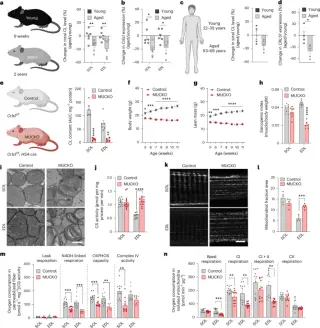
New Cornell-led research shows that even modest Vitamin B12 shortfalls can degrade aging muscle energy by harming mitochondria: B12 deficiency reduces mitochondrial DNA integrity and respiratory capacity, while short-term B12 supplementation in older mice doubled mitochondrial complex IV activity and boosted energy, suggesting blood B12 levels could guide precision nutrition to counter age-related muscle decline.

Pancreatic Cancer's Mitochondrial Inflammation Vulnerability Uncovered
science13 days ago

Pancreatic Cancer's Mitochondrial Inflammation Vulnerability Uncovered

Researchers at The Wistar Institute and ChristianaCare found that pancreatic cancer cells depend on an inflammation signal triggered by damaged mitochondria via the TLR3/TRAF6 pathway; blocking this pathway kills cancer cells and halts tumor growth in mice, revealing a potential therapeutic target for a cancer type with few effective options.

Mitochondrial Pearling Evenly Spreads mtDNA to Stabilize Cells
science18 days ago

Mitochondrial Pearling Evenly Spreads mtDNA to Stabilize Cells

Researchers reveal a process called mitochondrial pearling, where mitochondria transiently form bead-like constrictions to split and redistribute mitochondrial DNA nucleoids along their length, maintaining even spacing. This calcium-triggered, membrane-supported mechanism helps preserve mtDNA organization and could shed light on metabolic and neurodegenerative diseases, with findings published in Science.

Vitamin B12: A Hidden Regulator of Metabolism and Aging, Cornell Study Finds
science19 days ago

Vitamin B12: A Hidden Regulator of Metabolism and Aging, Cornell Study Finds

A Cornell study shows vitamin B12 influences skeletal muscle energy production and metabolism, linking suboptimal B12 status—common among older adults—to reduced muscle mass and potential aging risk; researchers suggest B12 biomarkers could enable precision nutrition, though findings come from cell models and aged mice and require human trials.

Non-death MLKL drives stem cell aging by damaging mitochondria
science1 month ago

Non-death MLKL drives stem cell aging by damaging mitochondria

Researchers at the University of Tokyo and St. Jude found that aging-related stress activates MLKL in hematopoietic stem cells not to kill them, but to damage mitochondria, weakening self-renewal and skewing blood cell production toward myeloid cells. Inactivating MLKL preserved stem cell function under stress, suggesting mitochondrial-protective or necroptosis‑modulating therapies could help maintain blood/immune health during aging or after chemotherapy/transplantation.

Shining light on mitochondria: the cellular science of red-light therapy
science2 months ago

Shining light on mitochondria: the cellular science of red-light therapy

Red and near-infrared light (600–1,100 nm) is thought to stimulate mitochondria by activating cytochrome c oxidase, boosting ATP production and triggering downstream changes in blood flow and inflammation. Alongside dermatology uses, a growing evidence base links photobiomodulation to benefits for ulcers, neuropathy, radiation skin damage, and hair loss, with FDA clearance for dry macular degeneration and ongoing trials in Parkinson's, depression, and post-exercise recovery. Notably, healthy cells respond little while metabolically stressed cells show stronger responses.