
New KRAS Vaccine Trial Shows Strong Immune Response but Raises G12D Paradox
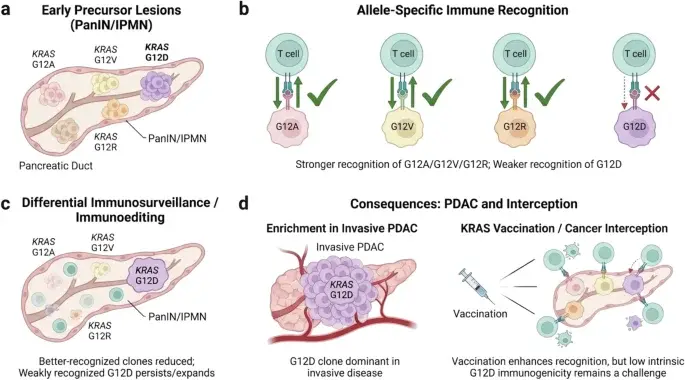
A first-in-human study demonstrates that a pooled mutant KRAS peptide vaccine can induce durable T-cell responses in high-risk individuals, potentially intercepting pancreatic cancer before it becomes invasive. While 18 of 20 participants showed strong immune activation, the vaccine elicited a weaker response against the G12D mutation, which is the most prevalent form in pancreatic ductal adenocarcinoma. This 'immunogenicity paradox' suggests that poor immune recognition of G12D may contribute to its evolutionary success in tumors. Although the trial proves the concept of pre-cancer vaccination, it was not powered to confirm cancer prevention, and broader phase 2 trials for similar vaccines have yet to show statistically significant survival benefits.
Key points
- Haldar and colleagues reported the first-in-human evaluation of mKRAS-VAX, a pooled mutant KRAS peptide vaccine, in 20 individuals with hereditary predisposition to pancreatic cancer and radiographic abnormalities.
- Eighteen of 20 participants met the prespecified immune-response criterion, with a median 18.2-fold increase in pooled mutant KRAS-specific T-cell responses; all adverse events were grade 1 or 2.
- The vaccine induced a significantly weaker response against the G12D mutation (8.3-fold increase) compared to G12A (43.9-fold), G12V (33.7-fold), and G12R (21.8-fold), despite G12D accounting for 41% of KRAS-mutant pancreatic cancers.
- Researchers propose that poor immune visibility of G12D may allow these clones to escape natural immunosurveillance, contributing to their high prevalence in established tumors and reduced vaccine responsiveness.
- While no participants developed pancreatic cancer during the 16.5-month median follow-up, the study lacked a control group and was not designed to prove preventive efficacy, highlighting the need for further trials to link circulating immunity to the elimination of precancerous lesions.
Background
This development follows earlier coverage of the 'cancer interception' strategy, which aims to treat precancerous tissue to boost five-year survival from 13.7% to 50%. Recent archive entries noted that while KRAS inhibitors like Incyte’s INCB161734 show high response rates in advanced disease, vaccine approaches remain experimental. A previous phase 2 trial of the camupepimut vaccine showed 99% immune activation but failed to meet primary survival endpoints, mirroring the current uncertainty regarding whether strong immune responses translate to clinical prevention.
How outlets are covering it
Nature emphasizes the biological implications of the G12D immunogenicity paradox, suggesting that allele-specific immune visibility may influence tumor evolution. In contrast, Medical News Today and Targeted Oncology focus on the broader clinical context, noting that while vaccines like camupepimut successfully activate T-cells in nearly all patients, they have not yet demonstrated statistically significant improvements in disease-free survival. NPR highlights the potential of personalized mRNA vaccines, citing a case where a patient remained cancer-free for seven years, though this contrasts with the pooled peptide approach in the primary study. Experts like Anton Bilchik and Jason Williams argue that while immune activation is a promising proof-of-concept, overcoming the immunosuppressive microenvironment of pancreatic cancer likely requires combination therapies rather than vaccination alone.
Why it matters
This study provides critical proof-of-concept for targeting oncogenic driver mutations before invasive cancer develops, potentially shifting the paradigm from treatment to prevention. Understanding why certain mutations like G12D evade immune detection could improve vaccine design and explain tumor evolution. However, the lack of definitive survival data in larger trials underscores that immune activation alone is insufficient, necessitating further research into how vaccine-induced T-cells interact with precancerous lesions and the local immune environment.
What to watch
Haldar and colleagues have initiated a 'window-of-opportunity' cohort to analyze high-risk pancreatic lesions during resection, aiming to determine if vaccine-induced T-cells traffic into and eliminate precancerous tissue. Researchers plan to investigate camupepimut in a phase 3 trial, potentially using additional booster doses and combination therapies to overcome immune suppression. Further studies are needed to clarify whether the G12D immunogenicity paradox is a biological barrier to interception or a design flaw in current vaccine strategies.
- Mutant KRAS vaccination for pancreatic cancer interception: the G12D immunogenicity paradox Nature
- This woman defied lethal cancer. Can mRNA vaccines make that possible for others? NPR
- Experimental pancreatic cancer vaccine shows promise in clinical trial Medical News Today
- Why Explore Vaccines After Pancreatic Cancer Surgery? Targeted Oncology
- How mRNA Technology Is Reshaping the Future of Cancer Vaccines? - The Royal Marsden NHS Foundation Trust Oncodaily
Want the full story? Read the original reporting
Read on Nature