
New Urine RNA Test Detects 95% of Bladder Cancers and Predicts Treatment Response
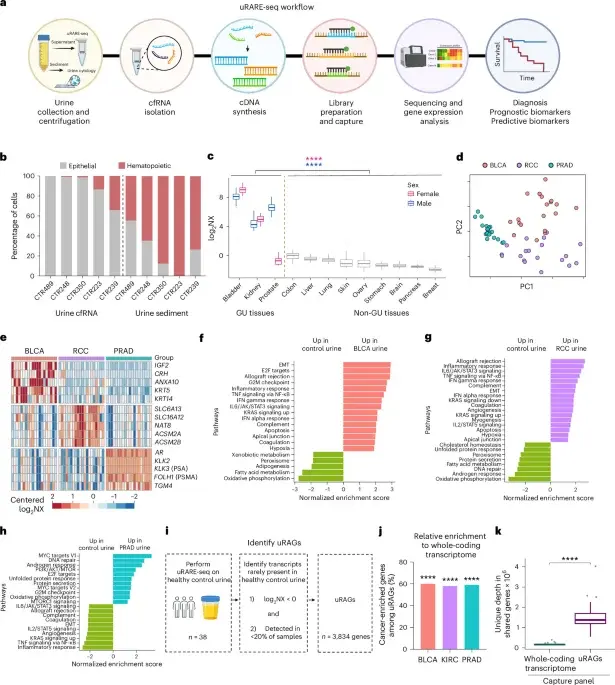
Researchers at Stanford Medicine and the VA Palo Alto Health Care System developed uRARE-seq, a urine-based liquid biopsy that detects localized bladder cancer with 95% sensitivity and 90% specificity. Unlike DNA-based tests, this method analyzes cell-free RNA to assess tumor activity, distinguishing between low- and high-grade cancers. The test also predicts whether patients will respond to BCG immunotherapy or require chemotherapy, potentially reducing the need for invasive cystoscopies and optimizing treatment allocation.
Key points
- uRARE-seq analyzes fragmented cell-free RNA in urine, offering a non-invasive alternative to cystoscopy, which misses up to 30% of cases.
- The test outperforms standard urine cytology and DNA-based liquid biopsies, avoiding issues with 'field-effect' mutations in normal bladder tissue.
- Pre-treatment RNA profiles reveal immune signatures in BCG responders, while non-responders show high proliferation markers, enabling a predictive biomarker with an AUC of 0.93.
- The method detects minimal residual disease after surgery and BCG treatment, distinguishing complete molecular responses from persistent disease.
- Prospective multi-center trials are planned to validate clinical utility, as current results are from a retrospective cohort of 683 samples.
Background
Bladder cancer surveillance is currently resource-intensive, relying on invasive cystoscopies that can miss up to 30% of cases. Recent developments, such as the Galeas urine test, have shown promise in detecting DNA mutations, but RNA-based approaches offer distinct advantages by reflecting active gene expression rather than static genetic changes. This study builds on prior liquid biopsy technologies, including CAPP-Seq, to address the limitations of DNA tests in the presence of field-effect mutations.
How outlets are covering it
Stanford Medicine emphasizes the test's ability to predict treatment response, highlighting its potential to optimize the allocation of BCG, a treatment with limited global supply. The Nature Medicine publication focuses on the technical superiority of RNA over DNA, noting that RNA analysis is unaffected by field-effect mutations. Newsweek and htworld.co.uk highlight the 95% detection rate as a major breakthrough for early diagnosis. All sources agree on the need for prospective validation, but Stanford Medicine places greater weight on the clinical implications for personalized therapy, while the scientific journal focuses on the methodological innovation.
Why it matters
This development could transform bladder cancer management by providing a non-invasive tool for early detection and treatment selection. By identifying patients likely to respond to BCG, clinicians can reserve this scarce treatment for those who will benefit most, while directing others to chemotherapy. This could reduce the burden of frequent cystoscopies and improve outcomes through personalized medicine.
What to watch
The researchers plan to validate uRARE-seq in larger, prospective trials across multiple centers. The goal is to confirm the test's clinical utility and potentially bring it to market through the Stanford spinout Resero Bio. Further studies will assess its performance in diverse populations and its integration into standard clinical workflows.
- Urine cell-free RNA for bladder cancer detection and treatment response prediction Nature
- Urine test may improve bladder cancer diagnosis and guide treatment decisions Stanford Medicine
- Stanford Urine Test Detected 95% of Bladder Cancer Cases Gadget Review
- Urine test may improve bladder cancer diagnosis htworld.co.uk
- Scientists Develop Simple Test That Detects 95% of a Common Cancer in Study Newsweek
Want the full story? Read the original reporting
Read on Nature