
New Blood Test Detects Early Pancreatic Cancer with 87% Accuracy
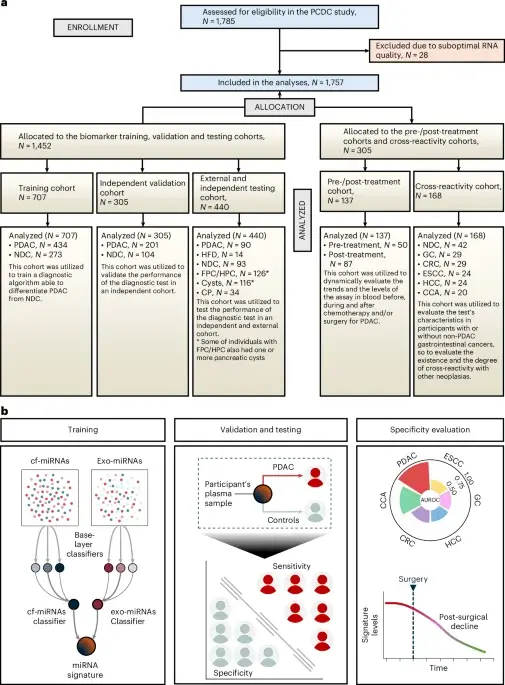
A new blood test called PANXEON has shown promising results in detecting early-stage pancreatic cancer, with a sensitivity of 86.8% for stages I-II and a low false-positive rate in low-risk groups. The test uses a combination of microRNA signatures and carbohydrate antigen 19-9 levels to identify the disease before symptoms appear, potentially improving survival rates for a cancer that is currently diagnosed at late stages in most cases.
Key points
- The PANXEON test was developed and validated in an international study involving 1,785 individuals across four countries.
- The test achieved an area under the receiver operating characteristic curve of 88.6% in the testing cohort, with a sensitivity of 83.8% for early-stage pancreatic cancer.
- When combined with carbohydrate antigen 19-9 levels, the test demonstrated a sensitivity of 86.8% for stage I-II pancreatic cancer.
- The test showed a false-positive rate of 3.2% in low-risk controls and 15.6% in high-risk controls.
- The test also demonstrated potential for detecting high-grade dysplasia in individuals with high-risk pancreatic cysts, with a sensitivity of 64.3%.
Background
Pancreatic cancer is one of the deadliest forms of cancer, with a five-year survival rate of just 13% due to late-stage diagnosis. Previous efforts to develop early detection methods have included various blood tests and biomarkers, but none have been widely adopted due to limited accuracy or specificity. The development of PANXEON represents a significant step forward in the field, as it combines multiple molecular signatures to improve detection accuracy.
How outlets are covering it
Nature emphasizes the technical details of the PANXEON test, including the specific microRNAs used and the statistical performance of the test in the study. Scientific American highlights the potential impact of the test on early detection and treatment, noting the low false-positive rate and the ability to identify precancerous signs. The Mercury focuses on the broader implications of the test for patients and the healthcare system, emphasizing the need for further clinical trials before the test can be used in clinical practice.
Why it matters
The development of PANXEON could significantly improve the early detection of pancreatic cancer, leading to earlier intervention and better survival rates. The test's ability to identify precancerous signs in high-risk individuals could also help prevent the development of cancer in the first place. However, further clinical trials are needed to validate the test's performance in larger and more diverse populations before it can be widely adopted in clinical practice.
What to watch
The next steps for PANXEON include larger-scale prospective studies to validate the test's performance in diverse populations and to determine its clinical utility. Researchers will also need to address the issue of specificity in high-risk groups, as the test currently has a higher false-positive rate in these populations. If the test proves effective in these studies, it could be integrated into routine screening programs for high-risk individuals, potentially saving many lives.
- Liquid biopsy for early detection of pancreatic ductal adenocarcinoma Nature
- Blood test shows promise in detecting pancreatic cancer early—a ‘holy grail’ for the field Scientific American
- Blood test shows promise for detecting pancreatic cancer at its earliest stages Medical Xpress
- New blood test spots one of deadliest cancers at its earliest stages themercury.com
- PanCAN Funds Sylvester Study of Blood Test for Pancreatic Cancer University of Miami
Want the full story? Read the original reporting
Read on Nature