
Semaglutide Extends Mouse Lifespan by 12% and Outperforms Calorie Restriction
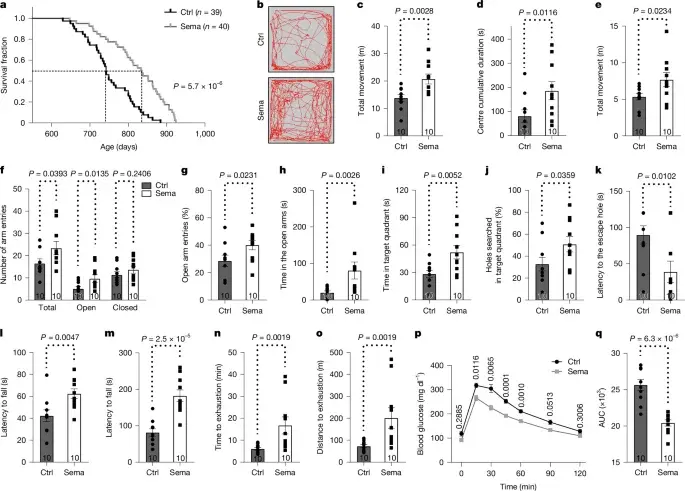
A new study in Nature shows that administering semaglutide to 20-month-old female mice extends their median lifespan by approximately 12%, from 742 to 834 days. The drug, known commercially as Wegovy and Ozempic, acts as a 'calorie restriction mimetic' by suppressing appetite and reducing food intake by 24%. Beyond weight loss, treatment improved physiological function, including spatial memory, motor coordination, and glucose control. Researchers found that semaglutide attenuated key hallmarks of aging, such as inflammation, cellular senescence, and genomic instability, while modulating conserved genetic regulators like sirtuins and insulin-IGF1 signaling. Notably, in a direct comparison, semaglutide produced more favorable outcomes in exploratory drive and memory than matched calorie restriction, suggesting benefits beyond simple caloric reduction. While the results are promising, they are limited to female mice, and human applications for anti-aging remain speculative pending long-term clinical trials.
Key points
- Semaglutide treatment in 20-month-old female C57BL/6 mice increased median lifespan by 92 days (from 742 to 834 days).
- The drug reduced food intake by 24% without significantly altering energy expenditure or locomotor activity, primarily through appetite suppression rather than willpower-based restriction.
- Treatment improved physiological metrics, including better performance in rotarod, inverted screen, and treadmill exhaustion tests, as well as enhanced glucose tolerance and insulin sensitivity.
- Molecular analysis showed semaglutide reduced hallmarks of aging, including lower levels of inflammatory cytokines, reduced cellular senescence markers (p16, p21), and improved mitochondrial function.
- Gene expression changes in the liver mirrored those of calorie restriction, particularly in downregulating inflammation and lipid metabolism while upregulating adaptive immune response and proteostasis.
- In a longitudinal comparison, semaglutide outperformed calorie restriction in specific cognitive and metabolic areas, such as spatial memory and exploratory drive, suggesting additional mechanisms beyond caloric reduction.
Background
This study builds on prior preclinical research indicating that GLP-1 receptor agonists like semaglutide have pleiotropic benefits beyond glucose and weight control, including reduced cardiovascular and neurodegenerative disease risk. Earlier archive coverage from September 2026 highlighted similar findings regarding lifespan extension in mice and the potential for these drugs to serve as anti-aging interventions. Recent studies have also explored the role of AgRP hunger neurons and Sirt1 signaling in mediating the weight-loss effects of GLP-1 drugs, suggesting complex metabolic pathways are involved. The current research adds a mechanistic framework by linking GLP-1 activation to conserved genetic regulators of aging, such as sirtuins and FOXO transcription factors, which are also targeted by calorie restriction.
How outlets are covering it
The primary source, Nature, provides a detailed mechanistic analysis, emphasizing that semaglutide acts as a calorie restriction mimetic but also offers superior benefits in memory and glucose control compared to dieting. Scientific American highlights the 12% lifespan extension and the potential for GLP-1 drugs to become anti-aging therapies, noting that the drug outperformed dieting in maintaining memory and blood sugar levels. The i Paper focuses on the public health implications, suggesting that these drugs could one day be used as anti-aging treatments for everyone, regardless of weight, while cautioning that mouse results may not translate to humans. All sources agree on the significant lifespan extension and the reduction of aging hallmarks, but they differ in emphasis: Nature focuses on the molecular mechanisms and comparison with calorie restriction, Scientific American highlights the potential for human application and the mystery of the drug's broad benefits, and The i Paper discusses the societal impact and the need for caution regarding human translation. There is no direct disagreement on the core findings, but the interpretation of the results' applicability to humans varies, with The i Paper and Scientific American expressing more caution than the primary source's mechanistic focus.
Why it matters
This study provides a mechanistic explanation for the broad beneficial effects of GLP-1 drugs, suggesting they may slow aging itself rather than just treating specific diseases. If these findings translate to humans, semaglutide could potentially be used as an anti-aging intervention, impacting a wide range of age-associated conditions. The discovery that GLP-1 activation mimics calorie restriction but offers additional benefits in cognitive and metabolic areas opens new avenues for research into longevity and disease prevention. However, the results are limited to female mice, and long-term human studies are needed to confirm these effects and assess safety and efficacy in diverse populations.
What to watch
Researchers are currently conducting a long-term lifespan study comparing semaglutide and calorie restriction to determine which intervention extends lifespan more. Further clinical trials are needed to evaluate the anti-aging potential of GLP-1 drugs in humans, particularly in older populations. The study also raises questions about the specific mechanisms by which semaglutide outperforms calorie restriction in certain areas, such as memory and glucose control, which will require further investigation. Additionally, the potential for GLP-1 drugs to be used as anti-aging treatments for everyone, regardless of weight, will need to be assessed in terms of safety, cost, and accessibility.
- Late-life semaglutide treatment slows ageing and extends lifespan in female mice Nature
- Could GLP-1 weight-loss drugs help you live longer? Scientific American
- The drugs found to slow down ageing – and you might already be taking them The i Paper
- "Mice Administered Obesity Drug Ingredient Live Over 90 Days Longer and Show Improved Cognitive Function" 아시아경제
Want the full story? Read the original reporting
Read on Nature