
Adult Restoration of Hippocampal Inhibitory Neurons Reverses Neurodevelopmental Deficits in Mice
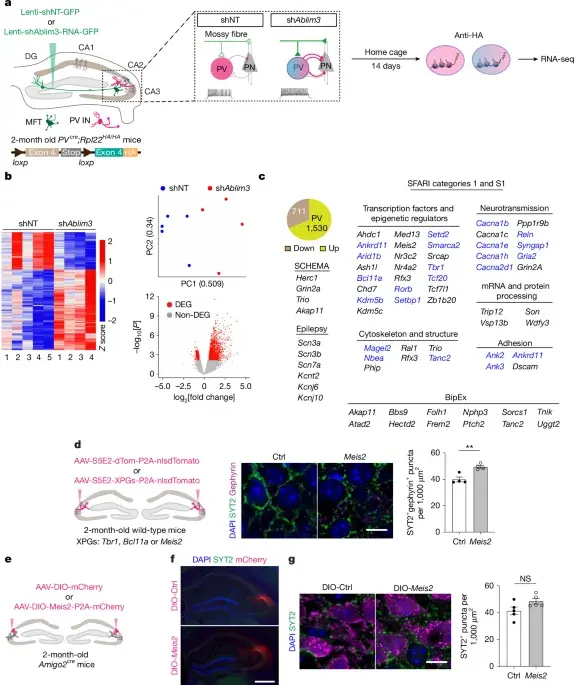
Researchers at Tufts University have identified a mechanism to reverse cognitive and seizure-related deficits in neurodevelopmental disorders by restoring plasticity in specific inhibitory neurons. Published in Nature, the study demonstrates that upregulating the gene Meis2 in adult mice can repair circuitry impaired by genetic risks associated with autism and schizophrenia.
Key points
- The study focuses on parvalbumin-expressing inhibitory neurons (PV INs) in the hippocampus's CA3/CA2 region, which regulate memory and cognition.
- Researchers identified 'experience-dependent PV IN plasticity genes' (XPGs) that are often haploinsufficient in disorders like autism, bipolar disorder, and schizophrenia.
- Targeted upregulation of the homeobox gene Meis2 in adult mice with an NDD risk model restored normal neuronal plasticity.
- This intervention improved cognitive function, stabilized neuronal ensembles, and suppressed seizures in the animal model.
- The findings suggest that developmental deficits in neural circuitry can be reversed in adulthood through targeted genetic restoration.
Background
This research builds on recent findings regarding the reversibility of neural structures in autism models, such as the 2026 study showing that chemogenetic activation can restore axon initial segment length in mice. It also aligns with broader epidemiological data from 2026 linking birth order to neurodevelopmental risks, highlighting the complex interplay between genetic and environmental factors in brain development.
Why it matters
This study provides a potential therapeutic avenue for neurodevelopmental disorders by demonstrating that adult brain circuitry can be repaired. By targeting specific genes involved in inhibitory neuron plasticity, it offers hope for reversing cognitive impairments and seizures in conditions like autism and schizophrenia, moving beyond early-life interventions.
What to watch
Future research will likely focus on translating these mouse model findings to human patients, exploring the safety and efficacy of upregulating Meis2 or other XPGs in humans, and investigating whether similar mechanisms apply to other brain regions or disorders.
Want the full story? Read the original reporting
Read on Nature