
Decades-Old Weather Cam Reveals 20-Year Sky History of New Zealand
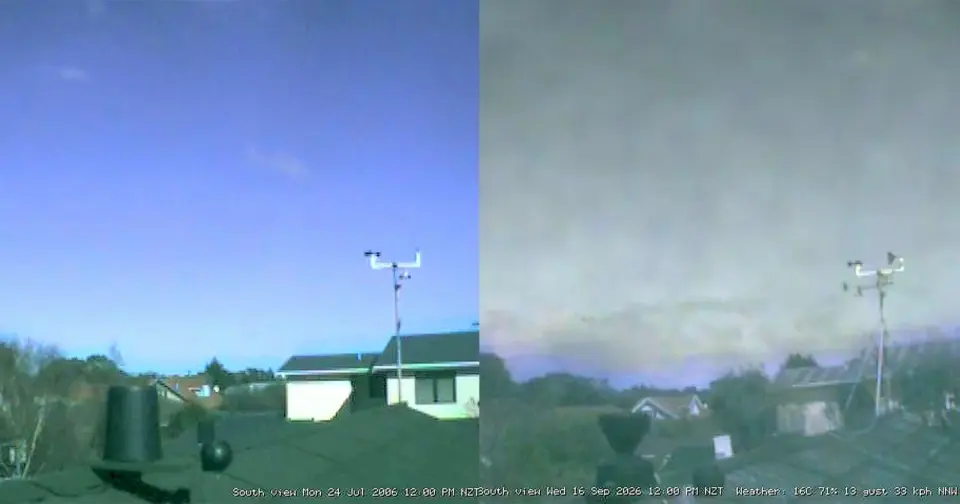
A 1990s-era weather camera in Lower Hutt, New Zealand, has produced a 20-year timelapse of local skies, capturing daily noon images from 2006 to 2026 despite aging hardware and environmental wear.
Key points
- Trevor McGavin’s south-facing camera in Lower Hutt has recorded 640x480 pixel images daily since June 2000, though the timelapse covers 2006–2026 due to data recovery limits.
- The footage, published by Peter McGavin, uses one noon image per day played at 25 frames per second, with each second representing 25 days.
- The camera, a StarDot Technologies WinCam Live, remains operational in 2026 despite decades of exposure to the elements.
- Processing reduced flicker and restored colors but created a hazy appearance, leading viewers to question the lack of sunshine; McGavin attributes this to sensor degradation, lens dirt, and playback speed.
- Lower Hutt averages over 2,000 hours of bright sunshine annually, with sharp shadows in the footage confirming sunny conditions despite the grayish look.
- The timelapse shows Southern Hemisphere seasonal changes and rare snow, with the only ground snowfall recorded on August 15, 2011.
Background
This story follows a broader trend of long-term environmental and astronomical documentation, such as recent astrophotography projects capturing celestial events over extended periods. While previous coverage focused on specific astronomical phenomena like meteor showers and lunar cycles, this timelapse offers a continuous, ground-level perspective on weather patterns and seasonal shifts in New Zealand over two decades.
Why it matters
The timelapse provides a unique, long-term visual record of weather and seasonal changes in Lower Hutt, highlighting the resilience of early 2000s technology and offering insights into local climate patterns. It also demonstrates how aging hardware and processing techniques can affect the perception of environmental data, emphasizing the importance of context in interpreting long-term observational records.
What to watch
McGavin may continue to maintain the camera for further long-term documentation, though the aging hardware and data recovery challenges suggest potential limitations. The timelapse could serve as a reference for climate studies or educational purposes, illustrating seasonal and weather trends in New Zealand over a 20-year period.
Want the full story? Read the original reporting
Read on PetaPixel