
Anesthesia’s Neural Signature Spans Evolution and Lab-Grown Brain Models
New research identifies a conserved neural signature of anesthesia across species and demonstrates that lab-grown human brain models can replicate these effects without deep brain structures.
Key points
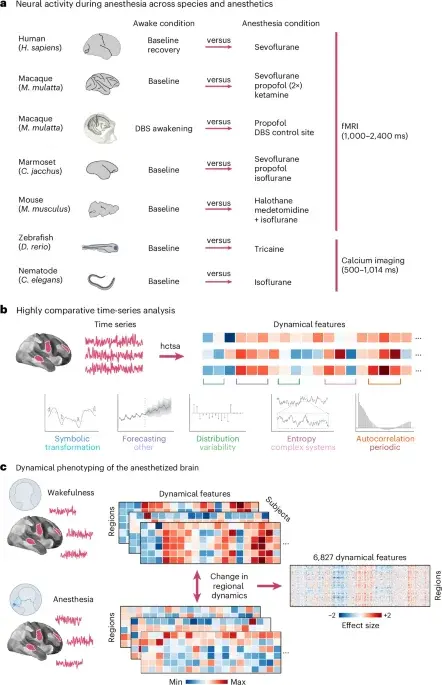
- A comprehensive study in Nature reveals that anesthetics induce a conserved dynamical profile across six species, characterized by shorter intrinsic timescales and dampened inter-regional synchrony.
- Deep-brain stimulation of the macaque centromedian thalamus reverses this profile, restoring behavioral responsiveness and confirming the link between neural dynamics and consciousness.
- UCLA researchers demonstrated that human stem cell-derived brain assembloids reproduce the slow brain waves of anesthesia using only minimal cortical circuits, without requiring the thalamus.
- Biophysical modeling links macroscale dynamical changes to microscale effects on synaptic excitation and inhibition, suggesting a common mechanistic endpoint for diverse anesthetic agents.
- The findings provide a new platform for studying how molecular changes shape large-scale brain activity, with potential applications for disorders like traumatic brain injury and epilepsy.
Background
Previous research has long debated the mechanisms of anesthesia, with some studies focusing on single species or specific anesthetic agents. The archive notes that a 2026 study identified a universal dynamic signature of unconsciousness, while another highlighted the role of cortical inhibitory neurons in sleep. The current findings build on these by providing a cross-species, data-driven approach to map the entire dynamic profile of the brain under anesthesia, overcoming the limitations of previous studies that focused on a handful of preselected features.
How outlets are covering it
The Nature study emphasizes the evolutionary conservation of anesthesia’s neural effects, highlighting a shared dynamical phenotype across species from nematodes to humans. In contrast, the UCLA research focuses on the sufficiency of minimal cortical circuits, challenging the long-held belief that deep brain structures like the thalamus are required for anesthesia’s effects. While the Nature study uses massive feature extraction across 6,000 time-series features to identify consistent changes, the UCLA team uses lab-grown assembloids to isolate and manipulate specific circuits, providing a controlled human system for studying anesthesia’s molecular and electrical hallmarks. Both studies converge on the idea that anesthesia reshapes brain dynamics, but they approach the question from different angles: one through cross-species comparison, the other through in vitro human models.
Why it matters
Understanding the neural mechanisms of anesthesia could lead to improved anesthetic agents, better monitoring of consciousness, and insights into disorders that alter brain dynamics, such as coma, traumatic brain injury, and epilepsy. The ability to replicate anesthesia’s effects in lab-grown brain models offers a new tool for drug screening and studying individual differences in anesthetic sensitivity, potentially reducing the risk of unintended awareness during surgery.
What to watch
Researchers will likely focus on validating the biophysical models and exploring the molecular targets of anesthesia in more detail. The use of brain assembloids may expand to other disorders, and further studies may investigate how specific genes and cell types shape coordinated brain activity. Additionally, the findings could inform the development of more precise anesthetic agents and monitoring tools for consciousness.
- Comprehensive profiling of brain dynamics during anesthesia across phylogeny nature.com
- Stem cell-derived brain models offer a new window into how anesthesia works UCLA Health
- What Happens to Your Brain During Anesthesia? Scientists Are Still Searching for Answers yahoo.com
- Conserved neural dynamics of anesthesia and the oblivion of species nature.com
Want the full story? Read the original reporting
Read on nature.com