
Mouse Brain Reuses Modular Neural Subspaces for Complex Cognitive Tasks
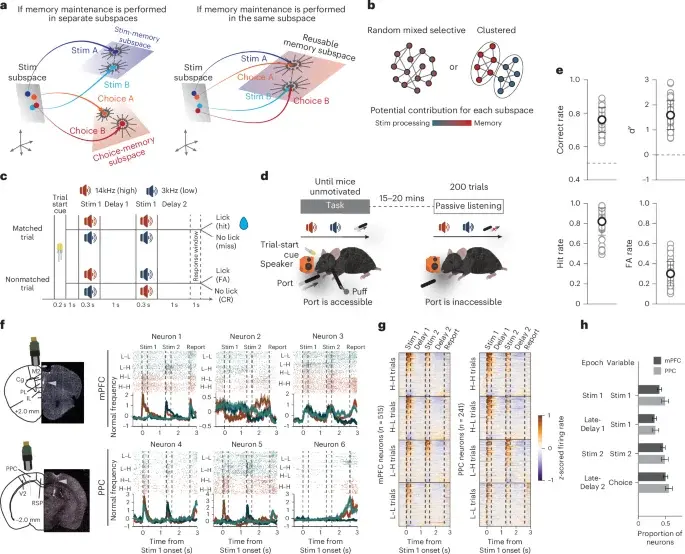
Researchers at MIT and Harvard have demonstrated that the mouse brain employs a reusable modular architecture to perform complex cognitive tasks, mirroring the efficiency of artificial neural networks. By analyzing neural activity during a delayed match-to-sample task, the study reveals that distinct neuronal subspaces in the prefrontal and parietal cortices are repurposed for different functions, such as stimulus processing and memory maintenance. This finding bridges the gap between biological cognition and computational models, suggesting that the brain achieves flexibility by combining specialized modules rather than creating unique circuits for every task.
Key points
- Mice performing a delayed match-to-sample with delayed report task reused specific neuronal subspaces for both stimulus processing and memory maintenance.
- Clustering analyses identified distinct neuron clusters in the prefrontal and parietal cortices that support these reusable subspaces.
- Artificial recurrent neural networks constrained by neural data confirmed that silencing specific clusters disrupted corresponding computations, validating the modular structure.
- The study provides the first direct evidence that the brain uses a modular, reusable architecture similar to that found in flexible artificial neural networks.
- Data and code from the study are available via Mendeley, supporting further research into the geometry of cognitive operations.
Background
This research builds on prior findings regarding the hierarchical organization of the prefrontal cortex and the role of shared mechanisms in working memory and attention. While previous studies, such as those by Badre and D’Esposito, suggested a hierarchical control system, and recent work by Tafazoli et al. (2026) explored compositional tasks with shared neural subspaces, this study provides direct evidence of modular reuse in the mouse brain. It contrasts with earlier observations of mixed selectivity in complex tasks, offering a more structured view of how cognitive operations are assembled from reusable components. The findings align with computational models showing that artificial networks can perform diverse tasks by flexibly combining functional modules, a capability previously hypothesized but not confirmed in biological systems.
Why it matters
Understanding the brain’s modular architecture could revolutionize the design of artificial intelligence systems, enabling more efficient and flexible cognitive models. By demonstrating that biological brains reuse computational components, the study offers a blueprint for developing AI that can adapt to new tasks without requiring entirely new structures. This insight may also inform treatments for cognitive disorders by identifying how specific neural clusters contribute to essential functions like memory and attention. Furthermore, it challenges the notion that complex behaviors require unique neural circuits, suggesting instead that the brain’s power lies in its ability to recombine existing modules, a principle that could enhance both neuroscience and machine learning.
What to watch
Future research will likely focus on mapping the full repertoire of reusable modules in the brain and testing their flexibility across a wider range of cognitive tasks. Researchers may also explore how these modular architectures develop and change with learning and experience. Additionally, the integration of these findings into AI models could lead to the development of more adaptive and efficient neural networks, potentially improving performance in multitasking scenarios. Long-term, this work could influence the design of brain-computer interfaces by leveraging the brain’s inherent modularity for more intuitive control systems.
Want the full story? Read the original reporting
Read on Nature